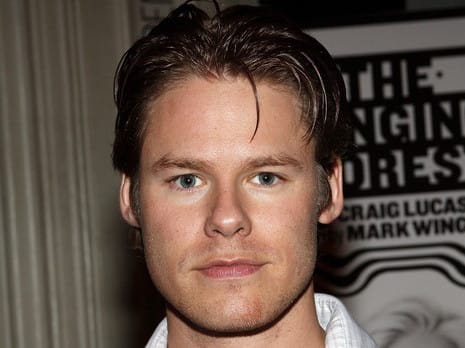
Growing up is no picnic, especially when the whole world and its gay brother remember you as a smooth young spring chicken. That, more or less, is the life story so far of Randy Harrison, who played Justin, the gay kid on the hit American series Queer as Folk.
From 2000 to 2005 Randy was synonymous with Justin, who started the groundbreaking series as a gay high schooler still working things out and finished it as a proud gay man about to marry the gorgeous Brian Kinney. In real life Randy is already 34, which doesn’t stop people from pointing it out to him all the time and asking how Justin is doing.
“The older I get, the healthier my relationship with Justin gets,” he says in an exclusive phone interview with Rating. “It doesn’t frustrate me anymore when people call me Justin. I’m used to it. I know people are constantly surprised that I grew up and look different, and a lot of them say so to my face. I think that’s insensitive of them, but I know the comparison is inevitable. I’m emotionally prepared, so it doesn’t hurt anymore.”
Soon we’ll all get to judge the change in Harrison for ourselves. The actor is about to pull a Justin Bieber and visit the Holy Land: he’ll be here for a week starting today (May 15) as a guest of the Israeli nonprofit channel Social TV.
During the visit Harrison will take part in conferences promoting the gay community, speak up for same-sex marriage and for gay tourism to Israel, meet the Knesset member Nitzan Horowitz and Yonatan Gher, director of the Open House, Jerusalem’s LGBT center, sit on a panel with gay teenagers, and star in a few other events that should warm the heart of Gal Uchovsky, the gay TV personality. “I got connected to Social TV through a friend of mine, Julia, who’s known me for years and also knows Israelis who work there,” he says. “They invited me and I decided it was a good fit. I really want to visit Israel.”
When exactly did you become an ambassador for the gay community?
“I went back and forth on that for years. When Queer as Folk was on, I felt the community really wanted me to be its ambassador, and I wasn’t that comfortable in the role. I felt I was more of an artist, an actor, than a politician or an activist. Only after I grew up and got some distance from the show could I be an activist in a way I was comfortable with. Today I’m completely at peace with it. I work with organizations in the U.S., I lecture at universities about equality and about marriage in the gay community. I think it’s mostly because of Justin that I connect with the young people’s side of it. I end up talking a lot with teenagers about how and when to come out. There are a lot of places in the U.S. that are hard to live in, where it’s hard for young people to come out. I help raise the issue, speak out against violence and bullying. Did you know that 40 percent of homeless youth in New York are gay?”
Yes, but what does that have to do with Israel?
“I don’t know the situation in Israel. Mostly I want to learn about your situation and also present the situation in the U.S. I’ll offer what I can. I’m planning to screen episodes of Queer as Folk and speak out against homophobia.”
Have you done this in other countries?
“Not officially. On my travels I end up appearing on a lot of gay TV shows and talking about it a lot. Naturally, everywhere I go, people the show touched want to talk to me about the community and about coming out. I’m totally fine with that.”
Out Since 15
Queer as Folk, as mentioned, was a real revolution in how gay men and lesbians were shown on American television. Where gay characters had made do with a hint of a sex life, Queer as Folk bombarded the screen with explicit sex, steamy kisses, wild parties and everything else that goes with the gay lifestyle. Justin, meaning Harrison, became an overnight star in gay circles and well beyond. “It was insane,” he says of the period. “We were hugely popular on a global scale. I have to admit that at the time I had a very hard time with it.”
Why?
“The pressure was hard for me. And I saw the show differently. I remember being frustrated by a lot of things. I thought some of the subjects were handled too simplistically, without any sophistication. Only now, looking back, do I appreciate how effective it was. At the time I was selfish. I thought more about what I wanted the show to be and less about what it was for people. I think Queer as Folk was a good show in that it started a conversation. It put things on screen that had been dodged until then. It was the beginning. People had never seen men making out before.
“On a personal level, so many young people still come up to me and tell me the show changed their lives. How can you not love hearing something like that? It made me realize we really did change people’s lives. We showed them there was a way of living they hadn’t known about, that they could live however they wanted. I didn’t get that back then. I watched the first two seasons and then I pulled away and didn’t watch anything. Recently I watched the whole thing and was pleasantly surprised. There’s real humanity in it. I’m proud of it.”
You were one of the few actors on the show who were out from the start.
“Right. It wasn’t hard, it was obvious to me. I’ve been out since I was 15 or 16. I never thought I’d be on television, I thought I’d be in the theater, and I always lived openly. The idea of living in the closet is unthinkable to me. It was never an option as far as I was concerned.”
What do you think of how gay people are shown on television today?
“I think there’s still room for improvement, but there’s a welcome shift underway. Ten years ago I was frustrated, and now I’m pleasantly surprised. You can see gay characters today on hit shows like Glee and Desperate Housewives. I think we had a lot to do with that.”
He’d Rather Do Theater
Since the series went off the air in 2005, Harrison has mostly done theater. He lives in Brooklyn with his two cats (Ella and Aggie, for those keeping track), acts in off-Broadway plays and in a theater company he founded, and is involved in short films and assorted art projects. Nice, but not exactly a series that airs around the world.
“Not going on to something big after Queer as Folk was a conscious decision,” he insists. “I felt that kind of pressure wasn’t natural for me. I didn’t want that kind of attention. After the show I wanted to rest. Now I’m more open to it, but I wouldn’t agree to do something that’s exactly like Justin. It depends on the writing and on the character they offer me.”
Isn’t it hard to move on to other roles when everyone knows you for one?
“I feel the work I do now depends on the history of my career, but it still stands on its own. After all, Queer as Folk started 11 years ago, and it’s been six years since it ended. The further I get from it, the more I see that I have a separate career, but I also appreciate that people want to talk to me about it. I used to get annoyed and think, ‘Is that all they want from me?’ But time has passed and I’m willing to talk about it and engage with it. It also depends where. Around the world, Queer as Folk really is the only thing I’m known for. In New York people respect me for the theater.”
So how do you sum up Queer as Folk? Good or bad for the career?
“In the end, for me the show didn’t change anything. The good and the bad of it left me on neutral ground. When it ended, I didn’t feel it was something I could build on. If anything, I felt I was starting over. That was frustrating, but also exciting. I knew what I wanted to be, and that was refreshing.”
You do know the gay community in Israel is very excited about your visit? It’ll be like throwing a steak into a lion cage.
Harrison laughs. “That’s exciting, it makes me really happy. I’d rather people were excited than not. But I won’t give it a second thought. I’m not planning anything on this trip. You can write that nobody has a chance with me.”