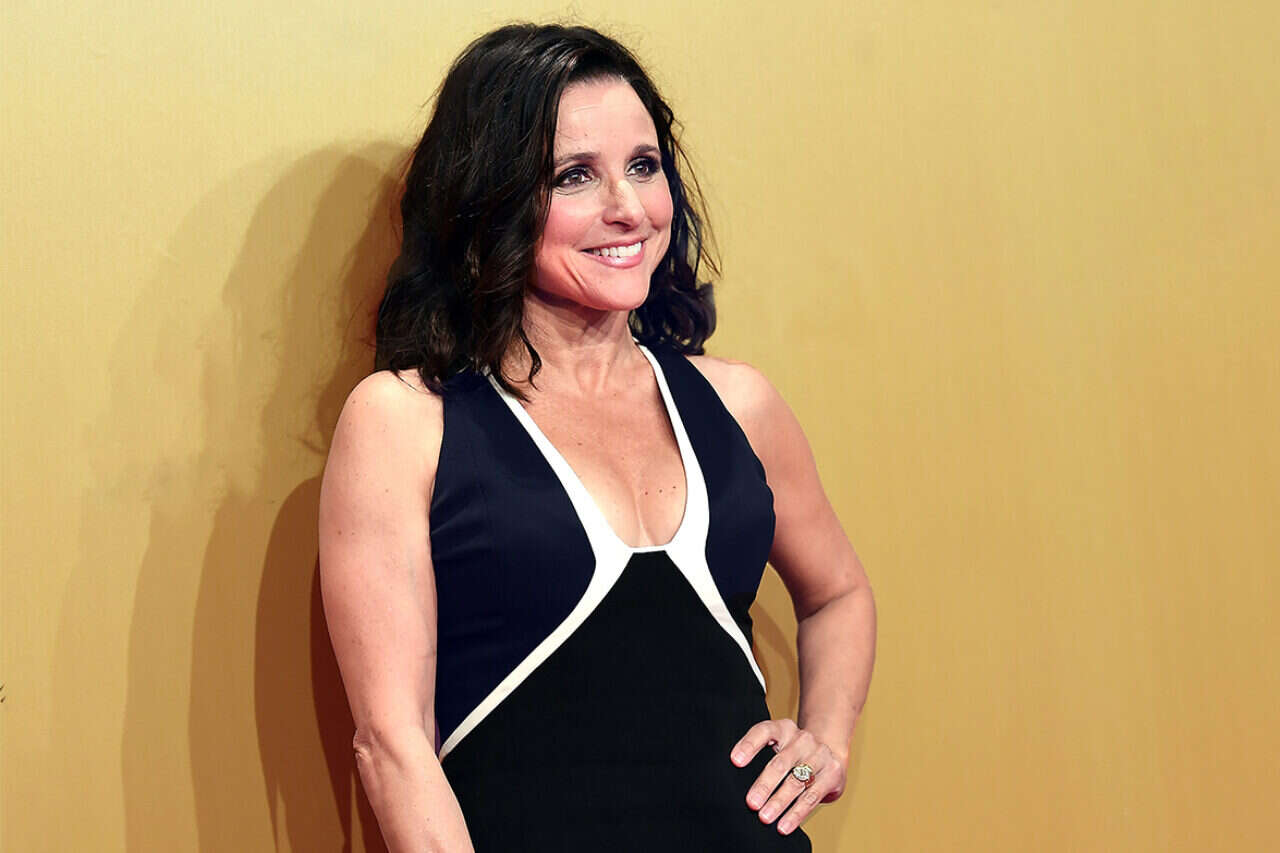
The past year gave Julia Louis-Dreyfus, a woman who meets life with a permanent sense of humor, little to smile about. “When they diagnosed me with breast cancer, I started to cry,” she says of the discovery of the disease in 2017.
It isn’t easy to watch a comedian tear up, but Louis-Dreyfus, having completed six rounds of chemotherapy and surgery, already sounds and looks recovered. “The treatments and the surgery were very hard. I felt sick to the depths of my soul, but I always knew I was going to come out of it, that I had to.
“Cancer makes you think, obviously. We’re not the same when we see the end in front of our eyes. I saw death. You could say I was a lot more lighthearted before the illness, but it made me understand that lightness isn’t something I can afford. It’s not that I’m heavy. I’m just a lot more awake and a lot more focused.”
Louis-Dreyfus, who shared her journey with her fans on social media, told Good Morning America this week: “I think I reached a lot of people. I raised a lot of money for women who have gone through mastectomy and reconstruction. Everyone’s support helped me get through the chemo. And now I’m completely back.”
Next week she returns to the screen in the seventh and final season of Veep, the political comedy she stars in (airing in Israel on yes, HOT and Cellcom TV from April 1). “I never doubted for a second that this season would make it to the screen,” she says. “If anything, the cancer gave me motivation. They say humor is the best medicine, and it isn’t a cliché. I needed the laughter in my life. I needed that goal.”
Since she first appeared as Elaine Benes on Seinfeld, Louis-Dreyfus, 58, has become one of the most honored actresses in television history, with a record-breaking haul of Emmys (nine for Seinfeld, six of them for her acting) and assorted other decorations. After several seasons of The New Adventures of Old Christine she stepped into the shoes of the battle-scarred politician Selina Meyer in the hit Veep. In the final season her character runs for president of the United States once again, surrounded by her team of incompetents and armed with a cynical attitude to life.
This season Meyer tosses off a stream of unseemly jokes about the disabled, about victims of shooting attacks, about the lower classes and about anyone who crosses her retina. All she cares about is the White House.
“You could say I’ve made a career out of playing pretty awful characters,” Louis-Dreyfus laughs when we meet this week at a New York hotel. “But even when Meyer is truly awful, I don’t see it that way. She’s very determined and very, very frustrated. There’s something interesting about frustration. Behind it there’s a lot of sadness and ambition. It’s much deeper than just being ‘awful.’ So she takes her frustration out on everyone around her.
“The way she talks to people kills me. For instance, one of her lines dressing down an employee who screwed up: ‘It’s like using a croissant as a dildo. It doesn’t do the job, and it leaves a mess!’” She cracks up.
You talk about her as if she were a real person.
“She exists. You see her everywhere around us. She’s a blend of a lot of women and men in politics and in other industries. You could say this is a show about Hollywood too, not just Washington. A show about selfish people trying to advance themselves by any means possible.”
How much are you like Selina?
“A lot. Tons,” she laughs. “Mainly, I can identify with her. I understand her frustration: being a woman who spends all day figuring out how to sell her brand. I do the same thing. There’s a great deal in common between surviving in politics and surviving in show business. Being a middle-aged woman trying to stay relevant and influential, I definitely understand the feeling. When the people across from you think you’re washed up and should go home, or when you’re not taken seriously, it’s infuriating.”
You, in your position, still feel that way?
“Yes. I’ve always felt I had to fight. It was hard for me to get the ability to produce my own material. I fought very hard for creative control. There was a lot of pressure against me, but in the end I won.”
What’s the trick?
“I can honestly say I have tons of experience in entertainment. I’m full of confidence that I have a lot to add.”
Louis-Dreyfus is the show’s undisputed boss. The whole crew worships the ground she walks on, showering her with compliments and catching its breath when she crosses the set. And still, she seems to work harder than anyone.
At the hotel where the interview takes place she has been going since seven in the morning without a break, hopping between interviews with media from around the world, huddling with the show’s producers, tying up loose ends on the editing of the next episodes.
Louis-Dreyfus takes off her high heels and stays barefoot. She sits down next to a producer in the hotel corridor, watches clips on a laptop screen and hands out editing notes. “I’m hearing ‘um’ too many times,” she remarks, and suggests trimming a scene. From there she goes back to the round of interviews, and there isn’t a drop of tiredness in her.
“A good leader is one who manages to set an example,” says Tony Hale, who plays her right-hand man on the show. “Julia is like that. She’s never off. She never has a bad day. And if she does, you’ll never know. She comes to work.”
Louis-Dreyfus demurs: “I think we’re all trying to do the best we can. It’s absolutely not just my show. Everyone works very hard.”
How does your role as a producer show itself?
“It’s a job that never ends. I’m involved in everything. At least I’ve changed. I used to watch every scene shot on a given day like a woman possessed, but I’ve learned to let go. When I watched myself I’d fill up with self-criticism, loathing and shame. Today I’m no longer that hard on myself.”
It looks like you work harder than anyone.
“It matters to me, personally. After the show’s original creator (Armando Iannucci. N.D.) left after the fourth season, I felt someone had to take the reins. I had to take command. I’m glad I did it, that I pushed HBO to keep going. I’m very proud of that.
“I have enormous respect for all the people who work with me, and it matters to me to be a kind of example or inspiration for them. This product is the result of 200 people working together, and to me that’s the magic of television. On the face of it you’d think you couldn’t get 200 people to do anything. And yet, we manage to turn out episodes.”
Why are you ending?
“It was my decision and the producers’. The network was willing to let us continue, but I felt the show had run its course. We’re ending at the point where I think we should end.”
Is it connected to the fact that reality itself has become more satirical than the scripts?
“Given the current climate, it’s much more challenging to try to push comic boundaries. On the other hand, we’ve always worked on the show without needing the characters’ political identity. None of them is defined as being on one side of the political divide, and we live in a confined universe that helps us advance the story, certainly now. In my opinion that’s the key to why our show has run for so many seasons. As far as we’re concerned, everyone is invited to the ‘party’ we throw on screen every episode.
“No question, reality today is a lot harsher. When we started it was the Obama administration, and look what’s going on in the White House today. All sorts of things we laughed about on the show have become unfunny jokes in real life. The current climate definitely affects the mood. Maybe it isn’t funny anymore. Donald Trump isn’t funny to me. I mean, he could have been funny if he didn’t have the power he has.”
I gather you’re not a great fan of the current president.
“To put it mildly. It shows in everything he does.”
Nothing in common between you, as president on screen, and him?
“The only thing is that we’re both pretend presidents. He’s playing a president too. He’s a president in pretend, in make-believe.”
Even though Trump’s spirit hovers over everything, there’s no mention of him in the current season.
“That’s deliberate. From the start the idea was not to represent reality literally but to be a satire of politics in general. This is actually the first season in which Trump was part of our lives. He was elected in 2016, after the previous six seasons had already been written. This season was written in 2017, and it was very hard to ignore what Trump is doing. Everywhere in the world people ask me about him. He’s become the face of America. To me that’s very sad. I didn’t want to take part in it.”
Do you find yourself laughing at the news, which, as you say, outdoes every line in the script?
“Yes, there are times when that’s exactly what I think to myself. Suddenly I feel it’s so extreme, even for our show. And still, it’s important to me to note that I play a woman who served as president of the United States, and that’s a reality we don’t know yet. That’s a line that hasn’t been crossed.
“I do feel the groundwork is there, that the ground has been prepared. Without going into detail, I think that’s a situation the new season’s episodes have already taken into account. In many cases the show touches on all kinds of real scenarios, whether deliberately or not, and that’s been its nature the whole time we’ve been on the air.”
Do you see a resemblance between actors and politicians?
“Absolutely. You’re a kind of brand that depends on relevance, selling an image to the public. You’re in a never-ending struggle to stay in the game. Every member of Congress who gets elected wants to keep their seat, and their head is already in the next campaign. An actor who lands a job also starts thinking about the next project so as not to end up unemployed.
“In both cases you depend on the current role, which in effect dictates which role you move on to. Add gender to the equation: I’m a woman who has worked in the industry for four decades, and the older I get the harder it is to stay in the picture. That’s true in politics too. Maybe in Washington it actually gives women power, as people with experience and connections built up over the years, but that’s true only for very particular women in very specific positions of power.”
Why not, in fact, bring the reality outside into the show?
“Because it’s political satire, not a parodic commentary on the current situation. I love parody, and certainly everything about the wonderful work they do at Saturday Night Live, but that isn’t our show.
“I grew up and learned a great deal in my three years at Saturday Night Live, in the early eighties. The competition was lethal. It was not a friendly environment for women, to put it mildly. It was a wild, drug-soaked scene I didn’t connect with, but it helped me sharpen what I did want to do as an actress. In my last year there I met Larry David, and then I found a partner in my misery.
“But on Veep you can’t compete with reality, and in fact we don’t mention any president after Ronald Reagan. We have a fictional history. In hindsight that proved itself, because the United States is so divided, and still everyone can feel that their political position is supposedly represented.
“We have advisers who worked in the Obama administration and in the Bush administration before it. I get reactions from both political extremes, each one delighted at how much we make fun of the other side. I’m amused every time it happens, because it’s proof that we’re doing a good job.”
Do you feel you represent American politics because of the show?
“When I travel in foreign countries I’m always asked my opinion of Trump. Even before they recognize me as Julia the actress, the moment they hear me speak English with an unmistakable American accent, the first thing they want to know is what I think of Trump. Apparently that’s what fascinates people outside the United States most. Of course they also recognize me from Seinfeld or from other characters I’ve played over the years. I was on a ski vacation in the Austrian Alps, and maybe because of the snowy atmosphere someone there recognized me from Christmas Vacation (a 1989 holiday film in which she appeared alongside Chevy Chase. N.D.). That one I didn’t expect.”
She wasn’t originally supposed to be on Seinfeld. The idea was an all-male show, but NBC insisted on adding a female character, and Elaine felt like an unwanted add-on.
“It took me time to find my place,” she says of her days on the legendary series. “The truth is that for years I felt they weren’t giving me jokes with any ‘meat.’ I had jokes, but they weren’t as strong as the men’s, to my taste.” And yes, she admits that some of the time she felt she was in a boys’ club. “Many times I heard Larry David and Jerry Seinfeld say they write Elaine as if she were a guy.”
In shaping the character she set herself the goal of being a voice for women in comedy. Louis-Dreyfus is known as a mentor to successful comedians of the new generation, Amy Schumer, for instance, or Abbi Jacobson of Broad City. Jacobson once said of her in an interview: “The characters we created on Broad City are a direct result of watching Julia and understanding that it’s allowed to ‘be like that’ as a woman.”
Louis-Dreyfus demurs: “I don’t think I ‘held the door’ for anyone. I don’t even understand what that means. Everyone earns her place honestly. I do see progress in the entertainment industry. There are many more roles for women in comedy than there were 20 or 30 years ago. There are roles that aren’t just ‘the wife of’ or the hot girlfriend. Most of the characters I’ve played have been single women. I’m rather repelled by ‘adoring girlfriend’ parts.”
Jerry Seinfeld has said that political correctness is nonsense and “anti-comedy.” Do you agree?
“Not at all. I’m in favor of political correctness. You could say I’m even a little suspicious of people who oppose it. I think what they’re really saying is that it’s fine to tell racist jokes or jokes about violence against women. That is really not fine.”
Well-founded gossip has stuck Louis-Dreyfus with the image of an heiress, a scion of a billionaire family. Her father, William, ran the Louis Dreyfus Group from 1996 to 2006, an investment company with holdings in real estate, gas, media and more.
“The media reports about my father’s wealth are very exaggerated,” she says, on the defensive. “They love to write that he was a billionaire, and about me they often write that I’m a billion-dollar heiress. That’s really not the case. Far from it.” Then again, when her father died a decade ago he may not have left billions behind, but there’s no arguing with the fact that this is a rich-plus family.
The art collection alone at her father’s country house in upstate New York was valued after his death at $50 million. The collection, together with other assets, went to an educational foundation in his name that helps underprivileged children. Louis-Dreyfus is one of the foundation’s directors. According to reports, her personal fortune currently stands at around $200 million.
Last summer her sister Emma died at 44. The cause of death was given as a stroke, and reports soon began surfacing that quantities of cocaine and alcohol had been found in her blood. The gossip papers rushed to declare an overdose. The fact that Louis-Dreyfus did not respond publicly and refused interviews on the subject only fanned the flames, and the tabloid front pages claimed the sisters had fallen out and were not speaking.
In a recent interview with The New Yorker, Louis-Dreyfus agreed to break her silence: “I kept quiet out of respect for my sister. It was a very, very hard time for all of us, shocking even. I didn’t feel it was right to talk about it with the media,” she explained.
What do you think of Israel?
“I’ve never been there, but I’d be very happy to visit. My grandfather is Jewish, but I don’t identify as Jewish. It’s part of my heritage, of the mosaic that makes up my identity, but there are other parts too.”
Louis-Dreyfus insists she’s less of a workaholic than Selina, though not by much. She recently finished shooting a feature film with Will Ferrell, and now she’s looking for the next challenge.
“There’s no television on the table right now, but I’m open to offers,” she answers with a smile. “I won’t say no to a good script.”
Would you do political comedy again?
“I don’t think so. I learned a lot about politics from this show. Mostly I understood that politicians are just people. That’s all. On the one hand that’s comforting, and on the other it’s terrifying, considering they have to run the show. It’s like visiting a sausage factory. You don’t really want to see how they’re made.”