On paper, Karim Rashid is a leading industrial designer, somewhere up there with Philippe Starck and Marcel Wanders (Time magazine once crowned him the most influential designer in America). In practice, much like Irit Rahamim, the Israeli event producer, or the Facebook page of Miri Regev, Israel’s culture minister, Rashid thinks of himself as something else entirely: a designer of atmosphere. As such, he knows perfectly well that God is not in the details but in the general vibe, in an experience greater than the sum of its furniture. We meet at his Manhattan studio to talk about his newest project, the Poli House boutique hotel, which opened recently in the center of Tel Aviv. “My ultimate dream, really, is to design a planet,” he laughs. “What I’d love most is to start a new world and design everything in it. Realistically, the last few years I’ve been interested in designing buildings, because that’s the closest thing. But it’s unpredictable work. When you plan a space you never know what the end result will be. You can know what color the walls will be or how the rooms will be laid out, but there’s an emotional, atmospheric component you can never predict. My goal is to create a particular energy, and I’m always nervous about whether it’ll show up.”
And at the Poli House, did it?
“I think so, but don’t ask me. You have to be there for the experience. The photos don’t do the place any favors.”
How did you end up designing a hotel in Tel Aviv in the first place?
“I got an email out of the blue, and the timing was very good. I was planning to come to Israel for a lecture anyway, so I met the developers. I loved the building, a Bauhaus from 1937. I saw right away that it had energy.”
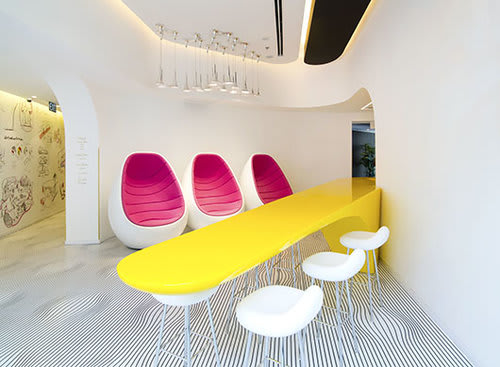
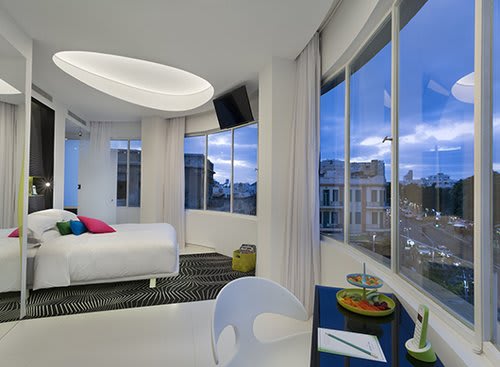
Did you like the city? And Israeli design?
“Yes, I know the city fairly well, I’ve walked around it a lot. I was very impressed by the Sarona complex, for instance. I thought they did a good job there. What I liked about Tel Aviv is the combination of a small place with the atmosphere of an urban capital. I love that mix of intimacy and globalness, and I tried to capture it in the hotel too.”
Rashid-land
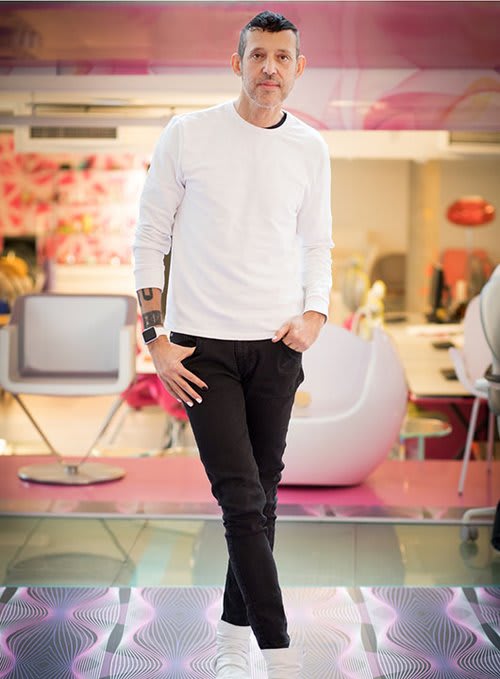
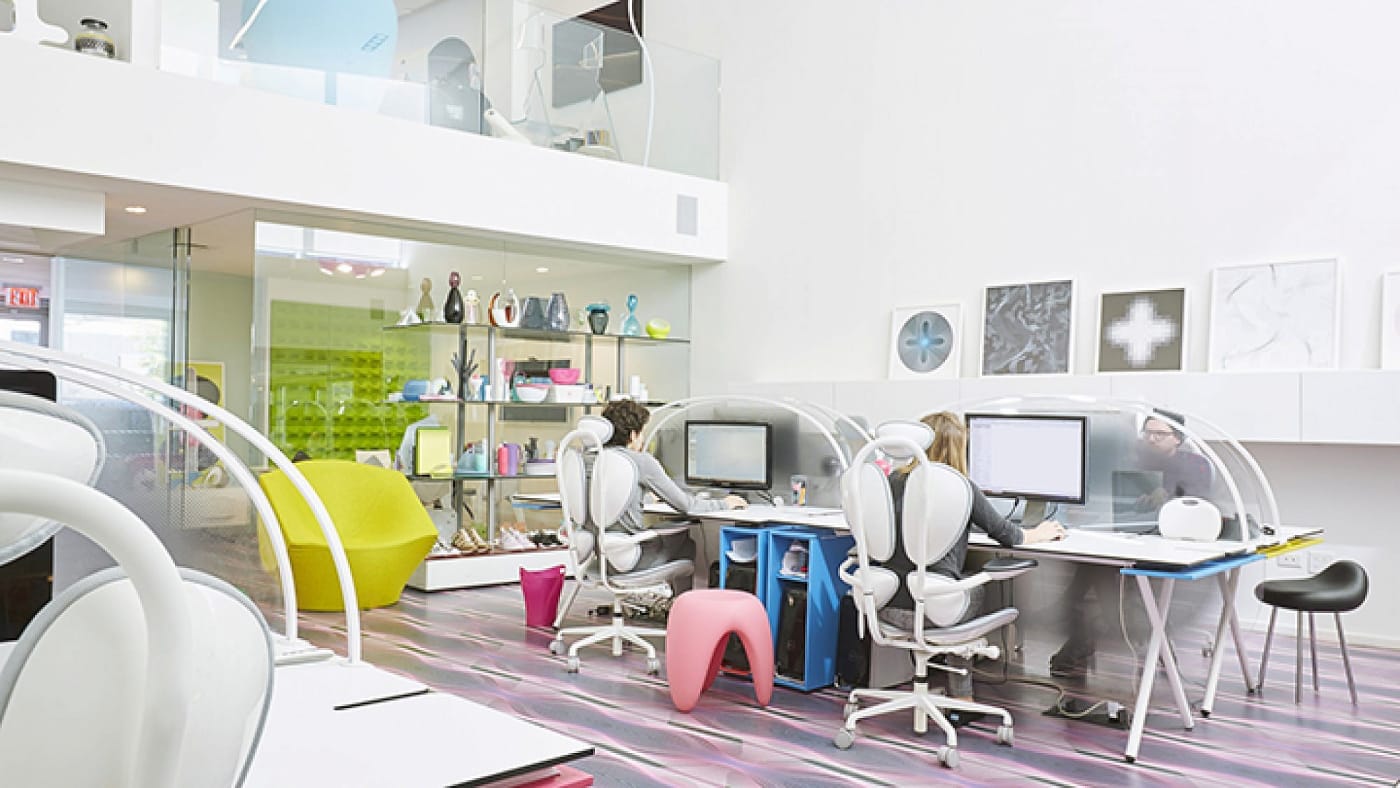
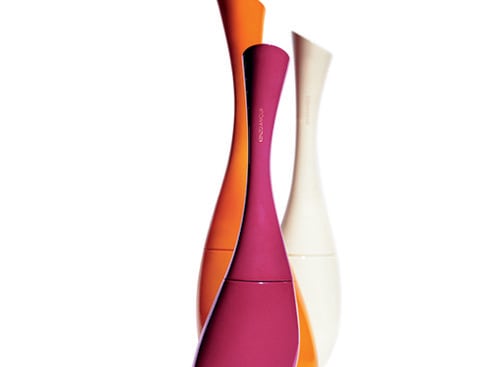
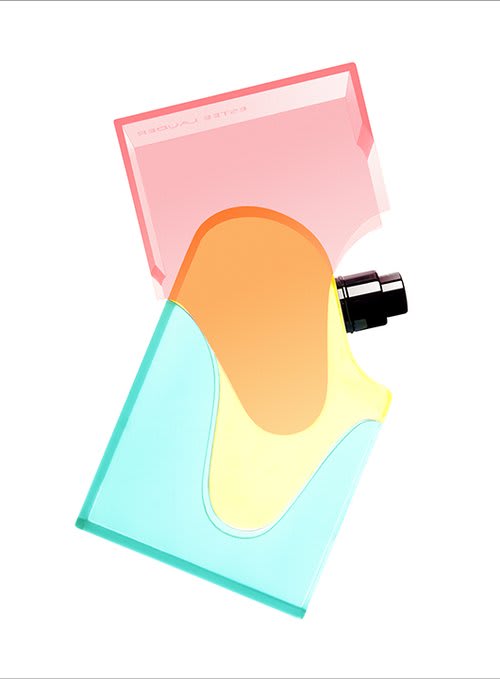
The experience of meeting Rashid is one he appears to have produced with care. The interview takes place in his big studio in Hell’s Kitchen, Manhattan, attached to the impressive private house where he lives with his wife and three-and-a-half-year-old daughter. Two things stand out immediately. One, the man is evidently rich (a private house plus a huge studio in the heart of Manhattan runs to some tens of millions of dollars). Two, this is a kingdom, and the kingdom is Rashid-land. Everything here was designed by Rashid, and I mean everything, from the pink sofas at the entrance (his favorite color and his trademark) through the futuristic bathrooms to the water bottles and the tape dispensers on the desks. All of it in pink and white, poppy, glossy and at times very nearly trashy. In the open space on the ground floor young designers sit at workstations wrapped in neon light, laboring over the various projects Rashid has going around the world. Around them stand glass cabinets holding a selection of his best-known work, which gives the place the feel of a small museum: space-age bottles for Pepsi, a wastebasket that sold in the millions, cosmetics and perfumes for Kenzo and Estée Lauder, even manhole covers and sneakers. His own desk is one floor up, overlooking all of it. He shows up an hour late for the interview, even though he lives next door, and still, when he finally arrives it’s clear this is a seasoned star who knows how to win a room without trying, on charm and a killer look. He’s dressed all in white, from the shoes of his own design to the lacquered fingernails, covered in elegant tattoos and keeping a figure that makes him look at least a decade younger than his 56 years. He also turns out to be a riveting talker who fires off existential insights at a dizzying clip. His plain clothes, for example, become a social statement that ties back to the Poli House: “I call the period we’re in the casual age,” he says. “Look at how you and I are dressed. People today are throwing off the heavy formality. The suit and tie don’t mean anything anymore. It’s a kind of uniform, and there’s no place for it these days.”
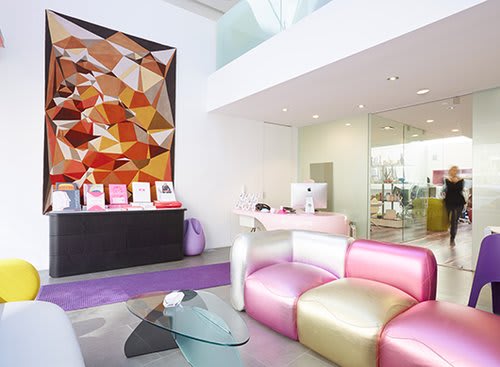
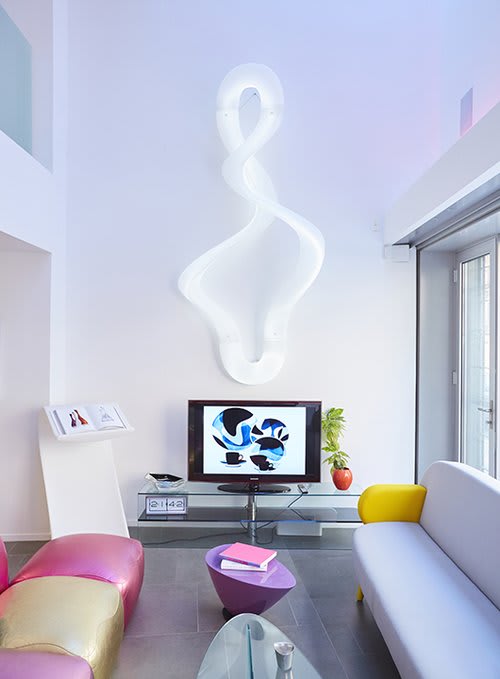
Is this you coming out against fashion?
“My problem with style in general is that it isn’t honest. We used to wear clothes to play a game. Now people are sick of pretending. Casualism means the CEO and the staff both show up in a Uniqlo T-shirt and feel fine. That’s the reality I’m aiming for, the world I hope to help build. Thanks to casualism we can be honest with ourselves and with each other, accept one another as who we are and not the part we’re playing. I think the whole world is moving that way. The world is going through a period of ‘new honesty.’ It’s an age of transparency, and I see it in every medium around me. Architecture, for instance: everyone builds in glass now. We used to put up concrete walls and partitions everywhere; now we try to have as little as possible between us and the world. I tried to apply that design honesty at the Poli House too. It’s part of the digital information age we live in. The hotel, and my work in general, communicate connectivity. It’s something I’m obsessive about in my work.”
So that’s your design agenda, basically?
“It’s something that’s been developing in me for the past 20 years. Ever since I got my first computer, an Apple, in the late eighties, I felt the digital age was going to gather force and change us in every area of life. It took time, but I think we’re at that point now, which is really the beginning of a new era. I like to say we’re Bioneers today, a cross between Pioneers and Binary. Until now we built the analog world, and now we’re moving into the digital one.”
Only now?
“The digital age is only 40 years old. That’s not a lot of time. There’s still confusion about how to fit technology into our lives, how to adapt to it. We’re still afraid of the future, partly thanks to Hollywood, which loves to show us a dark, bleak one. I don’t think it’ll be like that. Everything will keep improving. It’ll be better. It’s so clear to me what’s coming, and those are the things I feel I need to talk about in my work.”
But if the future is digital, nobody will need your work. You’re all about the tangible, about designing physical objects.
“True, but we’ll all be dead long before that happens. For the near future people still need the physical dimension. My agenda is to communicate the digital age through the tangible, to carry the digital message through analog. I look at the beginning of the world, at the Tower of Babel. We were given different languages so we couldn’t communicate with each other and reach God. And now, suddenly, we have one language again. We’ve come around in a giant circle. We’re marching toward one world again, a global village where the walls and borders disappear. It won’t happen in our lifetime, but humanity will get there eventually, to the point where we’re all one race again. We’re at the start of that process. It’s natural evolution. It’s the way we’re supposed to go. The skeptics, the anarchists, the resisters, none of them will manage to stop it. There’s no choice.”
Some would argue the opposite: that the future is a return to the caves.
“I disagree. I don’t think you should resist the revolution that’s coming. On the contrary, you should cooperate with it as much as you can. If we embrace the digital age we can quickly get past everything I call ‘analog bullshit,’ the stuff holding us back. Analog bullshit, to me, is territoriality, religion, wars. Those things are going to disappear because the world is going to be completely connected. The connectivity being created is amazing. Digital will wipe out racism. Technology lets us connect and move forward.”
Dirt Cheap
As an ambassador of border-breaking connectivity, guess what he thinks of President Donald Trump.
“To me Trump stands for everything that’s wrong with the world today. He scares me, with his semi-racist, quasi-misogynist statements. It’s like handing a small child enormous power to play with.”
Would you design one of his houses? Give the White House a refresh?
“He’d never ask me, but yes, I’d love to redesign the White House. Not for him. For the American people. As far as I’m concerned the White House belongs to the Middle Ages. It’s exactly the posturing I’m talking about. It’s ridiculous to me that in 2017 the White House is all chandeliers and heavy furniture. What does that have to do with the age we live in? Nothing. To me that’s dishonesty.” Since we’re talking about other people, it may be time to pause for a little criticism closer to home. Next to the grandeur of the Oval Office, for instance, a wander through Rashid’s studio does occasionally give off a faint whiff of cheapness. A thought that crossed my mind more than once about his designs is that a lot of them look like holiday gifts picked up at Soho, the design-gift shop in Tel Aviv’s Dizengoff Center, for an aunt in Ra’anana. Surprisingly, Rashid has no problem with the cheap look. He’s proud of it, in fact: “The floor here is 100 percent recycled wood at two dollars a square meter,” he crows. “Nobody can compete with that price. I design with it because it’s cheap. No nails. You lay it down, boom boom boom, done. My walls are glass, or prints I print myself, fast. Cheap materials and accessible technology, to me, are what today looks like.” Another plank of the design agenda is his commitment to the environment. “All my products are 100 percent recycled and biodegradable, no toxic materials. I’m a big believer that designers have to be responsible toward the environment they work in.”
Sustainability and recycling aren’t the first things I’d associate with your work.
“Most people make that mistake about me, purely because my design is colorful. That’s the only reason. It’s a hot topic now, but I was always like this. I was a kid when the wave of environmental awareness started. I grew up in Canada, one of the leading countries in the world for ecological thinking. When I went to university there, it was all we talked about.”
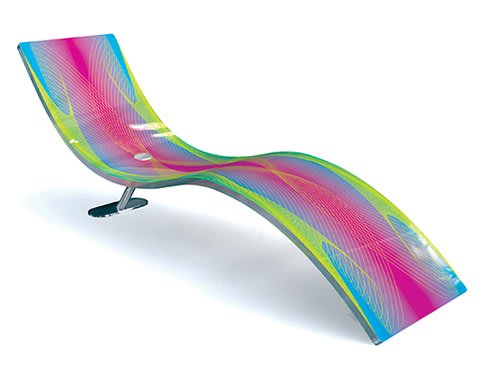
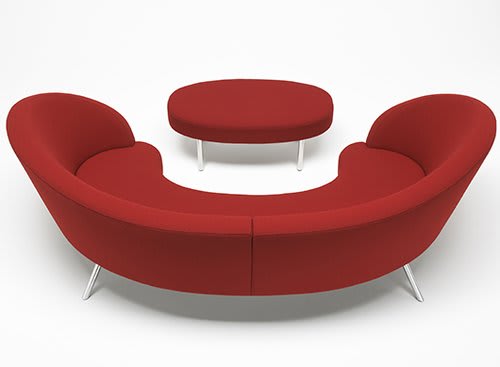
He has plenty to get off his chest here too: “What’s happening in the design world today on the environment is another example of dishonesty, as far as I’m concerned,” he says. “In so many restaurants now everything is wood, the tables, the chairs, and people think, ‘Ooh, nature.’ What they don’t know is that the way that wood is processed is hugely wasteful of energy, or that the materials in that furniture are far more toxic than plastic. It’s a lie. Every time I open a magazine showing ‘eco furniture’ made of wood I get angry. People don’t know that a lot of that furniture contains horribly toxic materials, carcinogenic even. The chairs I design, on the other hand, are cheap, practical, environmentally friendly, modular and comfortable, all at once. And the moment you’re sick of them you can grind them down and make something new. Another thing that annoys me is the industrial style, which is also very fashionable right now. In the past few months I turned down three big restaurant projects because they wanted the hanging filament bulbs, the metal stools. What’s good about that? It’s terrible for the environment. Why not use LED lighting instead, which lasts 40 years? It’s a fake style. It cheats the consumer. We should be living simple, fast, comfortable lives, instead of cutting down trees and burning energy to make furniture.”
Why do you think people miss that point, information revolution and all?
“That’s a flaw of the digital age too. People today are mostly shallow. We touch the surface but we don’t dig deep. On Facebook, for instance, every time I post something serious I get seven likes. If I put up a stupid picture of cats I get 3,000. That shallowness lets people fake an ‘ecological thinking’ ideology without really understanding what’s good for the environment.”
What future are you planning for your own career?
“I’m always trying to do things I haven’t touched before. I’ve done hundreds of chairs and tables already. I want new things, things people need. I want to design products for people with disabilities and special needs, for older people and the elderly. I feel it’s a market nobody pays enough attention to, even though there’s huge potential in it. The baby boomers are all past 60 now. The share of older people, which I’m starting to count myself among, is at an all-time high. And since we grew up with cool, innovative products, we want them when we get old too. My mother is 84, and there’s almost nothing on the market for her that’s cool and well designed.”
“A Girls’ Color”
Despite the name, Rashid, who was born in Egypt, is emphatic that he feels no connection to the Middle East. “I have no personal connection to the culture or the region. I have no connection to Arab culture. I feel nothing toward it. I left Egypt at two and spent most of my life in Canada and the United States. Since we left Egypt, neither I nor my family has had any tie to the place. My father never went back. We never spoke Arabic at home. People always ask me if I’m Muslim, and I tell them I don’t believe in religion. As far as I’m concerned I’m Canadian. That’s the country I grew up in, where I went to university and studied design. That’s where I absorbed the values that guide my life.”
Values you’re passing on to your daughter now?
“My daughter is three and a half, and I try to spend as much of every day with her as I can. It helps that my house is attached to my office,” he laughs. “My philosophy of raising her rests on two basic principles. The first is 100 percent honesty. She already knows there’s no Santa Claus, that death exists and that in the end we all get old and die. I feel the honesty helps her grow up smarter. The second is not to fall into clichés, especially about gender. There are no rules for being a man or a woman. Disney’s rules about princes and princesses are bullshit. I don’t want her growing up thinking some prince is going to come and rescue her.”
And yet pink is your favorite color.
“Because pink is a beautiful color, positive, amazing to my eye. I love it precisely because of the stupid rule that says it’s ‘a girls’ color.’ I stick my tongue out at it. I want to break the conventions, and I do it in pink.”