
The surprise came right at the top. Ryan Gosling had barely sat down to talk about his new film, The Place Beyond the Pines, in which he plays a professional motorcycle rider who turns to crime to support his son, when he asked, before anything else, how Israel’s motorcycle bandit was doing. “He was good, wasn’t he?” he says with a grin. “He’s my idol. I’ve read a lot about him.”
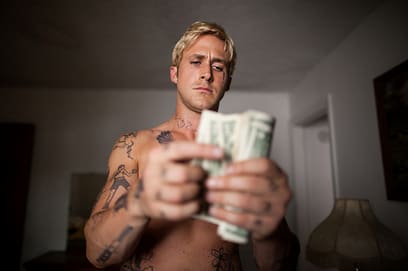
And he has done his reading. Gosling turned out to know the Roni Leibovitz story in impressive detail, and sang his praises to the whole room. “I love the guy because we think alike,” he says. “Before I’d ever heard of him, I had worked out an excellent theory of bank robbery: you pull up on a motorcycle, you rob the place with your helmet on so nobody can identify you, then you ride off and hide inside a truck, so the cops keep looking for a man on a motorcycle. I carried that idea around for years.”
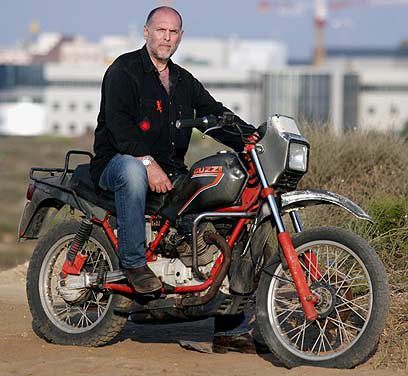
It sounds a little strange, but there’s a chance that an Israeli bank robber is what landed Gosling the part. The film was directed by Derek Cianfrance, who made Blue Valentine, with Gosling opposite Michelle Williams. “One night I was having dinner with Derek and he asked me what I’d most like to do in life,” the Hollywood heartthrob recalls. “I told him that if I could really do whatever I wanted, I’d rob a bank, but I’m scared of going to prison.
“And then he said, ‘Hey, I’m writing a script about exactly that.’ So I told him about the method I’d come up with, and then we developed the script together and figured out how the robberies would play out. All of those ideas were mine, inspired by the Israeli, whom I’d read about before I ever started imagining a heist.”
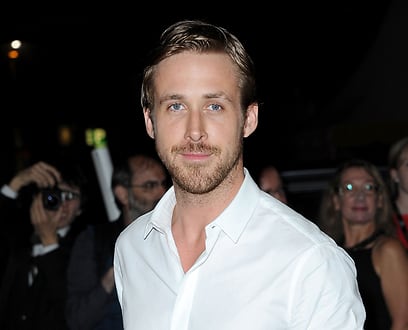
So, like your idol, you can ride a motorcycle?
“Yes, but not at the level of the chases and stunts in the film. In some scenes it really is me, and for that I spent a few months training with Rick Miller, the stunt rider from The Dark Knight films. The idea at first was that I’d do every scene myself, but I figured out pretty quickly that if you want to play in the NBA you need to have been shooting hoops since you were six. I wasn’t going to turn into a motorcycle bandit in a few months.”
Who’s a Real Man?
The Place Beyond the Pines runs a little deeper than your average action movie. It is also, or really mainly, a film about masculinity, violence, family, a despairing America, a failing school system and a long list of other sore spots in American culture, all rolled into one. “For my character the bank robbery isn’t the point,” Gosling says. “The point is dealing with the question of how you live with another man raising your kid.
“We built a character full of contradictions who’s trying to answer what makes a man a man. On one side he’s got the tattoos and the motorcycles, and then someone hands him a baby, and he realizes that everything that filled his life isn’t what actually makes the man.”
And yet the solution he finds involves violence.
“I feel like a lot of films fetishize violence. They make it cool. We didn’t want to do that. Yes, it’s a story about violence, but it’s not a celebration of violence. It’s a film about America, or the way I see it, about American tribes: our society is a set of traditions, and you’re basically born into choices that other people made before you.”
To keep the film as close as possible to the real America, the production went out of its way to put the actors inside it. “We shot the whole thing in Schenectady, New York, which is where the story is actually set,” Gosling says. “We wanted it real. They introduced us to local cops, and even to a man who had robbed a bank in that very town and done time for it. It was fascinating. He talked about what drove him to it, how it felt while he was doing it, the rush, and why he kept going back. Even in the robbery scene itself, everyone there except me, the tellers, the customers, even the guards, were mostly real people who had been through a robbery like that.”
You put people back inside their own trauma. How did that go?
“Honestly, at first it was a disaster, and not because of trauma. On the first take I burst into the bank to pull the robbery and I see one of the women behind the counter, instead of getting into character and panicking, just filming me on her phone. Other times people started laughing at me halfway through. They kept blowing it. By take 15 I was so angry and so worn out that I came into that bank screaming for real, gun drawn, and genuinely scared them. And then it happened. Suddenly the robbery looked real.”
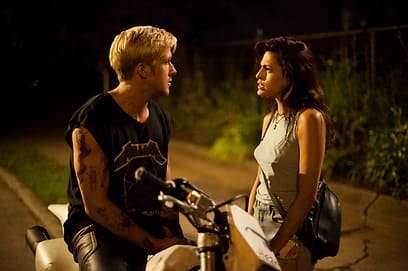
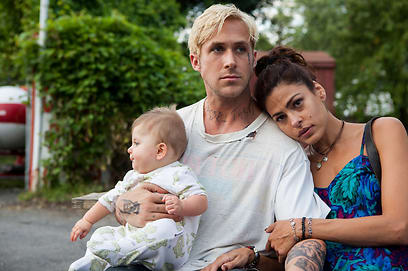
Another touch of reality: Gosling’s partner and the mother of his son is played by Eva Mendes, who is also his partner off screen. In fact, he is the one who brought her onto the film. “In general there’s a difference between a movie and real life. It’s like robbing the bank. I didn’t actually do it. The baby they gave Eva and me in the film was really cute. I loved him. If they’d handed him to me, I might have raised him. When there’s a baby around, your instincts kick in. You definitely feel something.”
Working with people you know: an advantage or a liability?
“Absolutely an advantage. There’s intimacy and history there, and not only with Eva. I’d worked with Derek before, and I’ve known him for years. That matters to me in life. It’s how I work. My manager, my lawyer, my publicist, my accountant, they’ve all been with me forever.”
When Gosling says forever, he isn’t exaggerating. He was born in Canada and moved to Hollywood with his family as a boy, to put the cute face to work as a child actor. He survived the move into grown-up roles and starred in films like The Notebook, Half Nelson and The Believer. Along the way he started turning up on lists of Hollywood’s sexiest men, and today he is considered one of the hottest properties in the business.
You survived the jump from child actor to the adult world.
“I actually think it helped me. It kept my feet on the ground. I can’t hide my embarrassing moments. You can google me and see my whole past. Sometimes I wish I could delete it, but in the end I’m glad, because I don’t take myself seriously. I know I looked ridiculous once.”
Thinking Outside the Six-Pack
He may want to grow up and be taken seriously as an actor, but right now Gosling is Hollywood’s hot kid, mostly on account of his abs, which he does his best to disown. “They’re not real. It’s Photoshop. Kidding. A little Photoshop and a lot of gym,” he jokes, and announces that he has no intention of taking his shirt off in his next films, to the disappointment of a great many female fans and of the journalists at People magazine and elsewhere who vote him onto the sexiest-men-alive list every year.
“I’ve been in a lot of films where I kept my shirt on, but everyone latched onto a handful of scenes and it snowballed. Suddenly I felt I was boxing myself in, so I’m not doing it again. No more undressing on film. I work very hard at staying varied and I’m very wary of being typecast. I can see a problem starting, so I’m deliberately taking different roles, roles that rest on the character, and I’m keeping my shirt on.”

Gosling much prefers the other compliment Hollywood keeps paying him, the regular comparisons to giants like Brad Pitt and George Clooney. Clooney even worked with him on The Ides of March, as co-star and as director.
Now Gosling wants to cross to the other side of the camera too, and is in fact directing a film about New York’s sex clubs. “George makes everything look easy, and it isn’t,” he says. “I’ve never directed, and it’s a long, complicated process that’s still ahead of me.”
So although he plans to explore the big city’s sex scene as a director, he insists on staying dressed from here on. Except that, like the strippers in his next film, it turns out he too will take it off for the right price. “Let’s leave it open,” he says, walking back the sweeping declaration. “The question is how much they’re willing to pay. For the right sum there’s a chance you’ll not only see me shirtless, I’ll do it singing and dancing.”