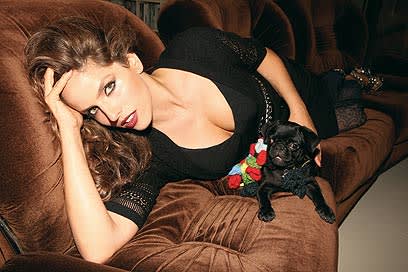
“I’m such a balabusta,” Noa Tishby laughs, as our conversation drifts from the Hollywood studio lots to foolproof shakshuka recipes. “But you know what, I’m a balabusta in stilettos.” Old-fashioned as it sounds, balabusta, the Yiddish for the woman of the house, the big mama who runs the show, is a word that fits Tishby nicely.
At 34, the actress-model-producer-dealmaker has a hand in nearly everything. She (take a breath) produces In Treatment, the American version of the Israeli series BeTipul, which has just wrapped its second season; is developing four more projects, two of them for HBO (American adaptations of the Israeli dramas A Touch Away and Screens); acts in prime-time series (parts in Big Love, NCIS and the pilot of the ABC legal drama The Deep End, all of which we’ll get to) and in films (Ghosts of Girlfriends Past, starring Matthew McConaughey); keeps a marriage going with Andrew Günsberg, better known as Andrew G, host of Australian Idol; and in general is swimming hard in the Los Angeles industry, where she moved about a decade ago.
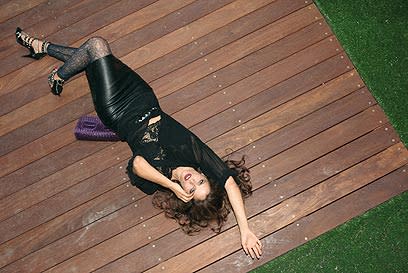
Last week she also popped up in Israel, this time to shoot the winter catalogue for the fashion label ml. As usual, she crammed the visit with countless meetings, interviews, shoots and talks, at a pace that would give an ordinary person a mild epileptic fit. In the time we spent together Tishby turned out to be a dynamo, an energetic businesswoman with a gift for instant intimacy.
“Honestly, I only came to shoot for ml, but while I’m here I’m doing interviews and taking meetings,” she says of her ten-day visit. “I came with my husband, Andrew. It’s funny, while I’m running around he’s sleeping. You know how you get to a vacation and just crash? That’s what happened to him here. It’s sweet. He’s asleep right now and it’s already noon.”
Tishby is an industry veteran, here and in Hollywood. She started as a teenager in the Neighbors, the pop star Tzvika Pick’s backing group. After army service in the Education Corps band she landed a major part in the soap Ramat Aviv Gimmel, then tried to launch a music career in the duo Nona with her boyfriend at the time, Gal Asher.
Always Hunting for the Next Thing
About a decade ago she moved to Hollywood, and after a few rough years the work started to pay off, in small parts in series like Nip/Tuck, Charmed and CSI: NY, in the film The Island and elsewhere. For the past four years she has been hunting for the next thing full time, in her producer’s hat. Since brokering In Treatment and coming aboard as one of its producers, Tishby has gone into the production business big time; her latest projects, as noted, are the Americanization of Screens and A Touch Away.
You started out in Hollywood as an actress, and you still act. Doesn’t the double life raise eyebrows?
“Maybe at first, because I’d walk into auditions and the producers would be surprised, since they knew me from the other side of the table. In my own projects I’m the one doing the casting. But now it’s great. It’s kind of funny, but since I started producing and stopped treating acting as the main event, I’ve been picking up parts on the side.
“I guess once the pressure’s off, auditions get a lot easier. But I really do love doing both. If it’s getting up at four in the morning for a shoot day, fabulous. If it’s getting up for a day packed with development meetings, fabulous plus. I enjoy it so much. Let’s say patience pays. It took me a long time, a lot of small, right steps, to get where I am, which to my mind is a good place.
“When I got to Los Angeles ten years ago there was nobody. There was Alon Aranya, a screenwriter and a good friend, there was Mili Avital, and that was it. In terms of talent and people on the ground, nothing. Now it’s the most fun. A lot of Israelis have worked their way into the industry, acting or otherwise, and there’s someone to talk to. Since In Treatment took off it’s a lot easier to get people interested in Israeli series.”
What’s the American market really like for Israeli shows?
“Like anything that’s in fashion, after In Treatment the American networks wanted to buy anything that came out of Israel. Almost every project drew interest, and tons of series got optioned. But as always, what makes it to the finish line is the quality stuff.
“Yes, there was a kind of wave, but it’s calmed down now. It’s less the hype of ‘anything from Israel is amazing’ and more taking each thing on its merits. Before In Treatment there was no option at all. I feel that with In Treatment I managed to open the door. How did it happen? I’m always telling people to ignore the word ‘no,’ because ‘no’ mostly means ‘not right now.’ You want something? So you say, ‘What about now? And now? And now? And now?’ and eventually they say yes. Today the door is open, but for the good stuff.”
Are a lot of Israelis trying to sell series in Hollywood?
“Tons. Everyone wants their series seen by as many people as possible, and there’s the money too, since in the United States they’re willing to pay a nice sum for good content. Though it’s not millions, the way everyone thinks.”
“Right Now I Have Four Projects Sold”
All well and good, but what does Tishby actually do? Follow her through a typical day, which usually begins in her fairly modest apartment in Echo Park, in central Los Angeles (“It’s a small apartment, not at all big the way they are in this city. But you can see the Hollywood sign from the window”), and you’ll find a worker as industrious as an ant, plowing the city in heels. She’s up between six and seven (“I’m the ultimate morning person”), sorts out the coffee and the dog, and goes straight into a round of meetings.
“I have a company, Noa’s Arc, that develops projects for television,” she says. “Right now I have four projects sold. I’m willing to talk about A Touch Away and Screens because it’s already been reported here that they’re happening. Both are still in development, meaning HBO bought the rights but not even a pilot has been shot. We’re still writing. I believe in waiting for things to ripen before you talk, but the head of HBO talked about the projects in the press, so who am I.
“There’s still a huge amount of work. The sale is only the first step. Now I have to make sure it gets made, and made well. The other two projects I can’t go into at all. I just don’t like talking about something until it’s completely locked.”
Why?
“Because the American system works differently. Things fall apart midway all the time. The whole process of selling a series takes forever. Between the point where a network likes a show and wants to buy it and the day it goes on air there’s a lot of work. Really, only people who live there get it. In Israel people get it less, because everything here is much faster. In Israel a channel buys a series and that’s that. In America it doesn’t work like that. First they buy an option, then they start developing, then they shoot a pilot. It’s a very long process.”
So how does it actually work?
“Case by case. Usually, as with Screens and A Touch Away, it starts with finding a series that would work in the American market. Once I have one, I start working on the pitch. Usually I look for the right writer, and together we pitch the project to the network people, show them the Israeli version and explain how the adaptation would work. I’ve been lucky, and these days I have an open door at most of the networks.
“The meetings are mostly at the level of the network president, the head of drama, the content people and the writer. For A Touch Away I came to the HBO meeting with Kate Robin, who wrote on Six Feet Under. We decided it would be a series about immigrants, because all of America is immigrants, after all. So we pitched it as a story about Orthodox Jewish immigrants in Williamsburg, Brooklyn. They loved it and we decided to run with it.”
“A Dream Is Wonderful, but You Have to Be Realistic”
At this point, is the check already in your pocket?
“No. Until it’s on the air I haven’t gotten anything. The writer and the creators get nice sums, on a level nobody in Israel is used to, but not huge. Usually it’s a few tens of thousands of dollars. Only once the script is approved and they start shooting a pilot do I see anything. Then the pilot has to be approved, and if it is, we go to work on the series.”
How much money is there in it?
“I can’t tell you. The contracts are very specific, and every network’s are different. I know that with In Treatment I was pretty bummed about how it came out. I wasn’t involved in the details, but I know the way the creators were compensated wasn’t good. It’s not done for the people involved to know what everyone else is getting, but like I said, there are no crazy prices. That much is clear.”
Why does that matter?
“It matters because this is basically the American dream. Most of the Israeli industry walks around dreaming of selling a series to the Americans and buying an island in the Caribbean.
“So I say: a dream is wonderful, but you have to be realistic, and it’s important to do it right and not be greedy. The big money comes, as long as you keep making things. Maybe in the first season you won’t get much, but in the fifth you will. I can’t play along with the fantasy. The big money comes once you’ve made a name for yourself. David E. Kelley, Alan Ball, Darren Star, they make money. Creators starting out don’t make a lot. Some of the Israeli creators are surprised by the numbers. We are in no way talking about millions of dollars.”
What about the recession? Is it hitting the market?
“The recession is definitely hitting it. People in the industry are careful, they look at what they’re getting for their money. Pilot season just ended, and it employed far fewer people than usual. Last year between 140 and 180 pilots were made; this year it was between 45 and 65. Usually most of my friends are working this time of year. This year I was the only one, with the pilot I did for ABC.”
An Authority on American Showbiz
Business talk comes naturally to Tishby. That’s no accident: over the past four years she has turned herself into something of an authority on American showbiz, and she seems to rather enjoy mixing a little business into the résumé.
“I’ve always been like this,” she says. “I always understood contracts, I always loved the business side of entertainment. Since I was 16 I’ve been involved in the marketing, the PR, everything around it. The people around me knew I’d end up on this side of things. It was only a matter of time, of age. Adding this layer was a natural move.”
But how did you work your way into the industry? To the point where CEOs will take a meeting with you?
“As big as Los Angeles is, the industry is tiny. Everyone talks all the time. Once you have a good name it spreads like wildfire. I suppose my name, which comes from the things I do and the way I do them, was good enough to spread. At some point CEOs and vice presidents started calling me. They want to work with good people. Everyone is looking for good content, and they look for it from people they trust. Apparently I’m one of those.”