Recently the children’s-channel star Meirav Feldman was photographed naked in a bathtub of spaghetti for the 7 Nights supplement. On the face of it, just another arty-nude photo of the kind, but since she represents the Children’s Channel, that stronghold of juicy yet innocent presenters, the lady earned a reprimand and a two-week suspension.
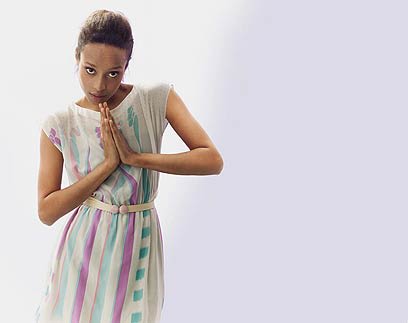
That may be why, when I sit across from Ester Rada, one of the stars of the channel’s flagship show, Deus, she is careful not to come across as too wild. And yet Rada, 24, Israeli-born and a daughter of the Ethiopian community, can’t quite keep up the front for very long.
With a childhood in Kiryat Arba, a departure from religion, an adolescence in a crime-ridden Netanya neighborhood, an expulsion from school, and stories of violence and drugs, it’s a little hard to come out looking presentable. Maybe that’s why, after the interview, I get a phone call from her asking me not to make her out to be too much of a delinquent. And honestly, she deserves it, because face to face Rada, a beauty if ever there was one, really does make a positive impression.
“I hadn’t heard at all about what happened to Meirav,” she says. “Personally, I’m crazy about her, and I’m sure she didn’t mean to cause an uproar. You have to understand that this is the channel we represent. I wouldn’t want you to write embarrassing things either. Not because of me, simply because children read it and see me as a figure they recognize from television. I wouldn’t want to set a bad example.”
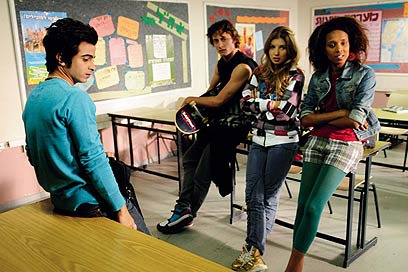
Unlike Feldman, Rada isn’t a children’s star one hundred percent, or at least not a full-time presenter on the channel. Her connection to the kiddie world is the series Deus, which deals with the world of computers and hackers and whose second season went on air three weeks ago. In the series she plays Adisa, a computer genius from a poor home who has a romance with Michael Moshonov’s character, in a cast that also includes Michael Lewis, Michael Aloni and Adi Himmelbloy, the premier league of children’s stars.
“There’s No Need to Keep Pointing Out That My Skin Color Is Different”
Besides being relatively unknown compared with the rest of the series’ stars, Rada also stands out as the only member of the cast with dark skin. But right from the start she stresses that this shouldn’t be the issue of the interview.
“Please, don’t let the whole interview be about my being Ethiopian,” she says, fixing me with melting eyes. “I’m not ashamed of it, heaven forbid. What do I have to be ashamed of? That’s who I am. But always, in every interview with Ethiopian artists, they talk about the whole ‘what’s it like to be Ethiopian’ thing. It’s a funny question. What does that mean? In the end, most of the article is about the background and not about the art itself, the acting. You can see that I’m Ethiopian. There’s no need to keep pointing out that my skin color is different. True, compared with most of the population I’m different, but my skin doesn’t need to be the issue all the time.”
On the other hand, it’s the card that sets you apart.
“True, the way other actresses are special because they’re blonde, or have green eyes. Everyone needs to have something unique, after all. So yes, I’ll always play a Black woman. That’s who I am. But my characters don’t always have to be Ethiopian. I can also play ‘just’ a Black character, a girl who happens to be dark-skinned. I can be anything, just in my color. The problem is that in Israel there are almost no roles like that. A screenwriter, when he writes, usually doesn’t imagine a Black character.”
But things are improving. Look, in Deus you have a lead role.
“True, and I really love the fact that it’s a significant lead role. But on the other hand, there are stereotypes there too. For instance, my character comes from a rough neighborhood and needs a scholarship to go to school.”
But she’s a computer genius.
“Why ‘but’? She’s simply ‘a computer genius,’ no ‘but.’ There’s nothing stopping an Ethiopian woman from being a computer genius. It can happen, why not. I have two little sisters on my father’s side and both of them are geniuses, I’m telling you. Gifted, skipped two grades.”
From Kiryat Arba to a Bubble in Netanya
Rada was born in Kiryat Arba to parents who immigrated from Ethiopia. Her mother is a caregiver in a nursing home; her father was a member of the committee that helped bring the community to Israel. Her parents divorced when she was young and contact with her father was almost cut off. She grew up in Kiryat Arba fully religious.
What was it like growing up in Kiryat Arba?
“Honestly, it was amazing. We were a religious family, we went to synagogue on Shabbat, we walked around in skirts, I thought about going to an ulpana, all of that. Back then it wasn’t as extreme as it is today. Actually, I didn’t know then what extreme was. I remember that after Baruch Goldstein’s massacre at the Cave of the Patriarchs, we used to go up to his grave and shout ‘Blessed is the man, blessed is the man.’ I was a child, I had no idea what it meant. Today I think about it and I’m horrified, but back then it seemed the most natural thing.
“We were raised to hate Arabs. Every other day we heard about a firebomb and some child who was killed. You understand that you’re in a daily war and you get used to thinking of them as the enemy. It was living in a bubble, you don’t see any alternatives. Only from a distance do I understand how cut off we were.”
From the bubble of Kiryat Arba you moved to another bubble, the bubble of a rough neighborhood in Netanya.
“When I was 10 we moved to Netanya, to the Azorim neighborhood, and that was a bubble too. I didn’t know any other life. Suddenly there are camps: Ethiopians hang out with Ethiopians, Russians with Russians, Moroccans with Moroccans. Only there did I have the revelation that I’m Ethiopian, because they started cursing me,” she laughs.
“Over there it’s much more hardcore. There I also had an adolescent crisis very quickly. I went from religiosity to a complete lack of faith in God. I said to myself, ‘How can there be a God when everything is bad?’ For a long time I didn’t believe in God. Only at 18 did I understand that everything is good and there is a God. I went back to believing. Today I’m religious in my own way. I don’t keep Shabbat, but I do believe. If I have children I’ll raise them to love God, but I don’t think they’ll be religious. I’ll teach them everything, and when they reach the right age they’ll decide for themselves. But it could be that a week from now I’ll be religious. I don’t know what will be.”
“In the Ghetto, Like in Any Ghetto, There’s Everything”
Off the record, Rada tells, or rather hints at, hard experiences she went through as a teenager in Netanya. When I ask her to clarify and elaborate, she goes straight back into her shell. “I’m not allowed, really. Because of the children who watch the Children’s Channel, I don’t want to tell what I did when I was their age. Let’s say there was a lot going on around me. In the ghetto, like in any ghetto, there’s everything.”
Fine, you’re turning Netanya into Harlem.
“Right, because it was a kind of Harlem. In the neighborhood I grew up in, you go downstairs and you see bongs or syringes. There was everything there. Look, I had hard times. I’m not hiding it. I wasn’t exactly the good girl from the ghetto who shuts herself up at home. Yes, I hung around there with the crews too and tried things. In middle school I was a real rebel. I started rebelling early. I tried everything. But in the ghetto there are levels, and I wasn’t at the worst level. I was wild, yes, but with an ethical code. I came from a good home, with an upbringing. So I didn’t completely fall apart.”
Did you get into fights?
“Honestly, yes. Once I got into a fight with a girl. Drop it, I told you, I wasn’t the classic story of the good girl from the ghetto. Yes, I mixed in. But I wasn’t stuck, I wasn’t at the most extreme level. I always knew I wanted to succeed in life, to work in music and art. Having something to aim for keeps you from being stuck. Most people in the ghetto don’t see a way out. The fact that there’s nothing to aim for is very frustrating and holds you back. I was looking ahead, so it was easier for me.
“Honestly, I only got a slap in the face when they threw me out of school. At the start of high school they threw me out because I simply didn’t show up. I was always hanging around the street. At that moment I understood, okay, we have to calm down. So I started showing up to class, more or less. At least a lot more than I’d shown up until then. In high school I calmed down. I met people there from the moshavim, or people who weren’t from the ghetto. That influenced me. By the army I was a good girl in every respect.”
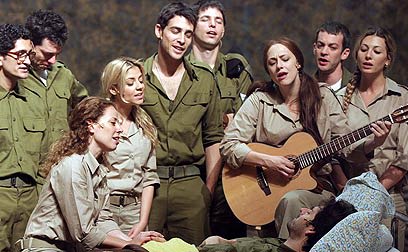
Rada always knew she loved to sing, and the moment she was accepted into an army entertainment troupe was a turning point in her not-so-simple life. After she learned to perform, and also calmed down (“I became disciplined”), she went to auditions for the musical The Troupe and, to her great surprise, was accepted, alongside figures like Adir Miller, Shiri Maimon, Muki, Keren Peles, Amir Fay Guttman and others.
“I didn’t want to go to the auditions at all,” she says. “I said, ‘There’s no Ethiopian woman in it, what would I do there?’ And anyway I’m a singer, not an actress. But in the end, because e-v-e-r-y-o-n-e from the army troupes went, I decided to go and audition too. To my surprise I got the role of Malka, the character Gali Atari played in the film. I won the Habima discovery-of-the-year award for the role, and I understood that I’m an actress too.”
In interviews with other actors, like Keren Peles, Muki and Shiri Maimon, they said or hinted that it was quite a nightmare backstage at that musical.
“Honestly, that’s true. There was a very big explosion of egos there. I remember crying a lot backstage, like a little girl. You wouldn’t believe how much I cried. For instance, when they asked us to stand in a line, everyone immediately wanted to be in the middle. They were really ready to kill someone to be in the middle. It amazed me. I didn’t know how to deal with it. I think it’s crazy how much the musical and reality mirrored each other. What happened backstage, all those egos, was exactly the same as in the plot. I think it also ended quickly because of those problems. But it was an experience I apparently needed to go through.”
“I Took the Filth of the Filth of the Acting World”
After The Troupe she got herself an agent, Rafi Agiv, went to the auditions for Deus and sailed through those too. This time she arrived hardened.
There are quite a few egos in Deus too. How did you cope?
“True, but after The Troupe it’s nothing to me. Understand that my first step into the acting world was The Troupe. I mean, some welcome. You could say I came to Deus after I’d taken the filth of the filth of the acting world, so I wasn’t fazed. But I did arrive there with crazy insecurity.
“In the first season I was depressed, even though nobody there had an ego or competitiveness on the level of The Troupe. It wasn’t comparable to them. It came more from where I was. Suddenly I felt it was a thousand sizes too big for me. All that chaos. Only in the second season, now, have I calmed down a little.”