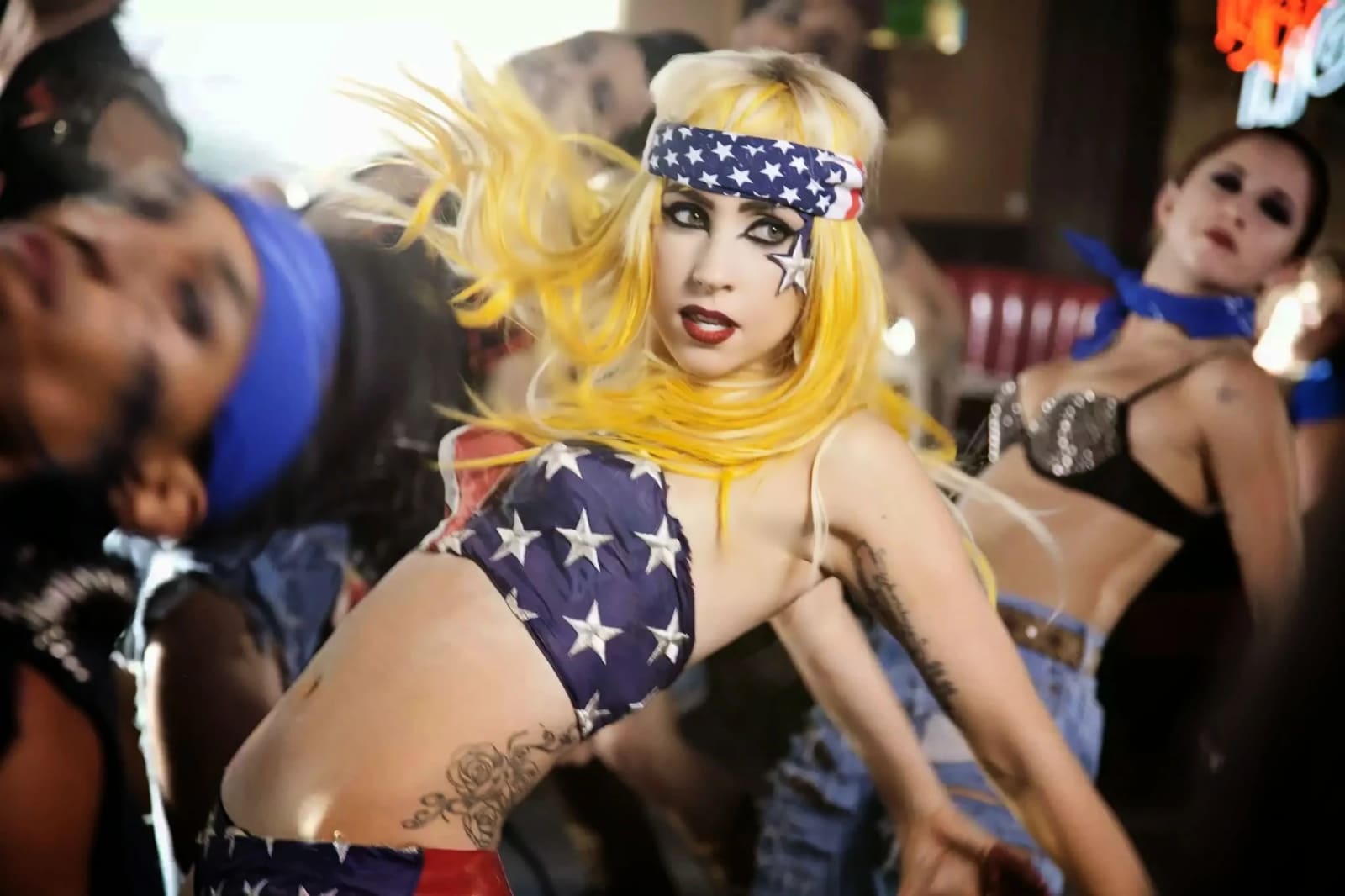
The story of Lady Gaga, at this very second the most talked-about pop star on the planet, is a story of faith and vanity. Gaga, or Stefani Joanne Angelina Germanotta to give her full name, always knew she was going to be a star. Or rather, a sort of global persona called “Lady Gaga”: a colorful, moonstruck, spiritual, slightly unhinged character she drew with her own hands and released into the tabloid air.
Since childhood she fed on the pop culture around her and dreamed of the day she would conquer the scene. It worked. Today she sings about paparazzi, fame, celebrities and love, covers herself in diamonds and deranged fashion, and sells a certain idea of New York glamour.
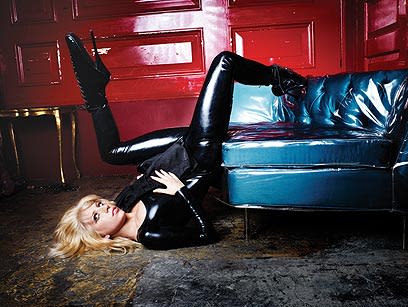
The world, for its part, has embraced her. Her first three singles went to number one in America; her debut album, The Fame, has sold more than four million copies worldwide; she was nominated for a Grammy; she leads the MTV Video Music Awards field with nine nominations (ahead of Britney Spears and Eminem, level with Beyoncé); she was recently shot for the cover of Rolling Stone by the celebrity photographer David LaChapelle (who declared her his new muse); and she has already worked with the Pussycat Dolls, Kanye West, Akon and others.
She is now in the middle of a world tour, The Fame Ball Tour, which is taking her to nearly every country on the globe. She’ll get to us too, at the height of it all, as part of Pelephone’s Non Stop Musix festival: August 19 at the Tel Aviv Exhibition Grounds, on a bill with Kaiser Chiefs and Simple Plan.
Right now she’s in Tokyo, driving the Japanese wild with hairdos and a parade of surreal wigs (her hair was purple for a minute, and at one point she appeared with what looked like a dead animal on her head) and with interviews more extreme still (in which she confessed to a fondness for monsters and to a mystical ability to foresee what happens in the pop world).
Five Years Back, at NYU
In honor of her Israel visit we were granted a phone call with the Lady, direct from Tokyo. I arrive at the interview a little starstruck. Apart from the fact that I adore her (“Poker Face” is, as far as I’m concerned, the song of the year), we also have a line in common on the résumé: I knew Gaga, or Stefani, back when we were both students at New York University, five years ago.
She studied music and I studied other things, but I knew who she was because of Gaga, who was already in business back then. In those days she was a kind of party promoter and downtown personality, running nights at the clubs that mattered and performing around lower Manhattan. Those were the years she invented the alter ego called Gaga, colorful, glittering, sexually blurry, and strutted it around the city. Then she took off. Today the very clubs she used to promote are playing her songs.
Once an excited Japanese operator has connected us, I remind her of our shared era. “Wow,” she laughs. “That was four years ago, something like that. I’ve changed radically since then. I left school and so much has happened. I was 19, making music, studying music, wearing underwear. A different time.”
If I remember right, you were deep in the party scene then. You also did your share of drugs, and you’ve even talked about it in interviews.
“Yes. There were a lot of drugs back then. I’d go around to parties doing all kinds of things I choose not to do today. That was a dark time. Now I’m in the light.”
Before we go on, a word on how Stefani Germanotta turned from party girl into global phenomenon. She was born 23 years ago in New York to fairly comfortable parents of Italian descent. Her father is an internet entrepreneur; her mother works in telecommunications.
Through childhood she took private music lessons (piano included) and attended a posh Catholic school alongside Paris and Nicky Hilton. When it was time for college she enrolled at NYU to study music, but her head was elsewhere.
The idea of Lady Gaga was already cooking. At 19 she signed with Def Jam Records, a deal that didn’t last. Undeterred, she started performing in clubs around the city, promoting parties and appearing in assorted burlesque shows, in one of which she stood in a swimsuit and blew soap bubbles at the audience (later she would explain that this was “art, and anyone who doesn’t get it doesn’t know what they’re talking about”).
“Even My Family Started Calling Me Gaga”
Around then she teamed up with a local drag queen named Lady Starlight, and the two became close friends. Starlight helped Gaga sharpen her style and brought her into the gay community. Their joint show became the talk of the town, and Gaga, personality blazing, began to make a name for herself. At 20 she dropped out and signed with Interscope Records, initially as a songwriter.
After becoming the protégée of the singer Akon, she went to work on her debut album, The Fame, released in 2008. It was a runaway success and spun off a string of hits that climbed high on the charts: “Poker Face,” “Paparazzi,” “Just Dance” and more. Gaga was nominated for a Grammy, joined the Pussycat Dolls on tour, and bit by bit became a worldwide phenomenon.
“Call me Gaga,” she asks before we continue. “Even back then, when we were in school together, people called me Gaga. It’s been like that for years. All my friends call me Gaga. Even my family started calling me that, though more as a joke.”
But Gaga is a kind of fictional character, isn’t she?
“No. Gaga is a work of art, but she’s completely real. Gaga is me. There’s no difference.”
Gaga considers herself an artist down to the last fiber. Even the sentences she releases into the air come wrapped in a faintly sophisticated aura, usually followed by a pause with a whiff of self-importance about it. She has a New York, Andy Warhol way of talking (more on him on page 56) in which every sentence is delivered slowly, as if she has just handed the world its next verbal Mona Lisa. Her concert, too, she describes several times as “a pop show for museums.” Leonardo da Vintage.
“I always knew I was going to be a star,” she says, between one pause and the next. “I knew it was my destiny to tell stories. Lady Gaga is a story. What I do is tell a story to the audience, to the world. I always knew I would do this. I knew I’d make music, too. I always wanted to live artistically, creatively. I’m so happy I got lucky and it worked.”
It worked in a big way. The last two years must have been madness.
“No. The madness is here and now. The madness is today, it’s tomorrow. These past few months the madness around me has been the biggest it’s ever been. I have three singles at number one. I’m nominated for the MTV awards. The madness is stronger than ever. I feel it, and I like it.”
Congratulations on the MTV nominations. Nine of them, more than any other artist, an honor you share with Beyoncé.
“Thank you. It’s exciting. It’s all thanks to the good people I’ve worked with.”
So what’s the secret?
“There’s no secret. I work hard. I have a good house of artists around me. I think the secret is that I collaborate with good people. That’s why it works.”
“It Was a Great Honor to Perform with the Pet Shop Boys”
Speaking of good people: a great deal has been written about how Lady Gaga is, in fact, badly out of tune, and how the secret of her success lies in super-slick production. Meaning the producers are the ones who put the sting in songs like “Poker Face,” while live, Gaga turns out to be a C-minus singer. One look at this year’s Brit Awards, where she sang a tribute to the Pet Shop Boys and was as off-key as a run-over cat, was enough. When I ask her about it, she says: “I was very emotional at that moment. It was a great honor for me to perform with the Pet Shop Boys.”
Are you aware of the criticism that “Gaga” is more production than talent?
“That’s just not true. I write all my songs. I compose them. I work with the producers. I am Gaga. That doesn’t contradict the fact that I have good people with me helping along the way.”
The songs Gaga wrote, at least the ones on the album, are mostly about fame: the love of it, the hunger for it, the trouble with being famous. Which is a little funny, since they were written long before she was famous herself.
“I talk about glamour. You don’t have to live it to do that,” she says. “I talk about a glamorous life even without real glamour and cameras around. My songs are about vanity. You don’t need to be famous to understand them. Vanity is a good thing. All my work is about image, about a lie that eventually becomes the truth. I want my fans to feel famous, to feel like stars. I’m telling a story about a dream, about New York, about glamour you create for yourself.”
Speaking of New York, do you miss the city, with all this traveling?
“I miss the city, and I work there too. I’m everywhere. I go back to New York sometimes, but right now my focus is the work. I do what I do for the kids, my kids back home.”
Which kids are those?
“The kids are my friends. Everyone who supports me.”
The full term is “club kids,” New York slang for the party-and-glitter crowd who rode along on Gaga’s meteoric rise. But even if she supposedly does what she does for them, not all of them are feeling generous. On my last visit to New York, for instance, I ended up at a party with those very kids, the gang that ran with her through her NYU days and her years of parties and club gigs around the city.
At some point “Poker Face,” the song that shot her into orbit, came on. “You know the difference between us and her?” asked Steven, a failed actor who used to hang out with her, gesturing at his friends. “She’s up there,” and he pointed at the monstrous speakers her voice was pouring out of, “and the rest of us stayed down here.” That bitterness, apparently, is the mood among Gaga’s friends from the New York scene, who feel a little left behind.
Do you feel your friends from the party days are behind you? You basically lived out their dream.
“Everyone has a story to tell,” she says. “Right now I’m telling mine.”
So all your friends are famous now?
“I don’t have famous friends. Maybe one or two. I don’t pick people by how famous they are.”
“It Took My Father a Long Time to Accept What I Do”
Gaga may not surround herself with celebrities, but she generates plenty of press on her own. The hot topic in the entertainment media right now, for instance, is the rumor mill around her sexual identity, the latest scoop being that Gaga is actually a man.
As evidence, a YouTube clip has been making the rounds showing a moment from a concert in which she lifts her skirt and appears to reveal a bulge in her underwear. The website Bossip.com promptly published an “interview” with her, fabricated in all likelihood, in which she admits to being a hermaphrodite, that is, to having both female and male genitalia, and says she loves her penis.
Her manager rushed out a vigorous denial, and the lawsuit is presumably on its way. Asked about it, Gaga would rather not. “I don’t talk about myself or my private life,” she says. “All those rumors are ridiculous to me, and I prefer not to address them at all.”
You’ve always been very provocative. I remember when you were starting out, you’d go out to parties nearly naked. You once said in an interview that your parents refused to speak to you in that period.
“Yes, it was new and strange for them. They didn’t understand that it was art. It took my father a long time to accept what I do. He gets it now. Today he sees me as an artist. He understands that what I do is create, not just provoke.”
And the creating takes you far.
“It does,” she laughs. “Because of my work I’m in a different country every day. Today Japan, tomorrow South Korea, then the Philippines, then China. Music is a powerful thing. It carries me around the world. Because of it I travel, I meet the fans, I write music, I design. I live a life full of passion.”
And full of money.
“Not necessarily. Now that I’m making money, I put all of it back into my art. Into the shows, the costumes, the videos. I haven’t bought myself an apartment. I don’t waste my money on nonsense like clothes, apartments and the good life. I don’t have a home of my own. I have nothing. Everything goes back into the event that is Lady Gaga. I love investing in design. The bubble piano I play in the show, for instance, I designed myself. I’m a full partner in designing my videos.”