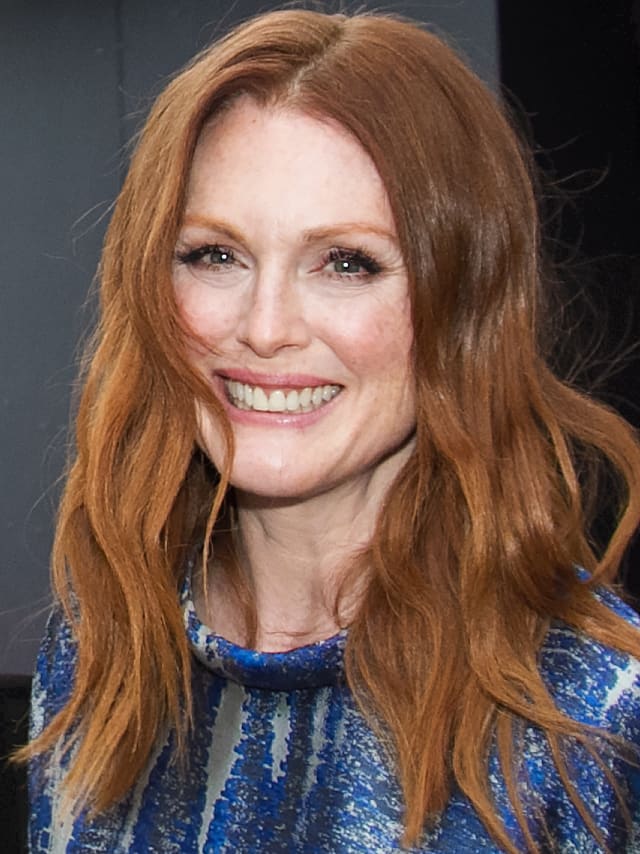
Julianne Moore is exhausted. Her day has barely begun and she already feels like she’s facing a firing squad. “I’m tired, please have mercy on me,” she asks as she walks in, trailing a cloud of sweetish perfume, to our meeting at the Regency Hotel in New York. Honestly, she’s allowed some mercy. It isn’t easy, after all, to spend a whole day being interviewed by a pack of barracuda journalists armed with nagging questions. Freedomland, the film Moore has come to promote, got a fairly chilly reception from the American critics. So most of the interview came down to why, how much and what on earth possessed Moore to make this film. A typical question, for example.
You spend most of the film having a nervous breakdown. Why, exactly?
“That’s the script, and that’s what they gave me: cry the whole time. That’s the job. You learn to get inside the character, to understand why she’s in the state she’s in. I’m not doing it for nothing, if that’s what you’re asking.”
Before we go on digging into the lady, some background. Julianne Moore, 46, is one of the busiest actresses in the film business. For years now Moore has moved lightly along the line between serious actress and stunning model. In the past two years alone she has turned up in lead roles in four different films (The Forgotten and The Prize Winner of Defiance, Ohio among them), and five more with her name on top are due out over the next two. Not to mention the fat endorsement deals with Revlon and Montblanc.
“I don’t think I work too much,” Moore sighs, “but because of all kinds of distribution issues I’m aware there’s a feeling that people are getting a bit of an overdose of me. So I made a few films over two years, they all happened to come out close together, and suddenly the press is asking, ‘What’s wrong with her? Why do we have to see her all the time?’”
If anything, the American press seems relatively gentle with you.
“That’s because I’m probably not that interesting. When you think about it, most of the attention these days goes to young people, the Jessica Simpsons of the world. Probably because a lot of the interest comes from people who are young themselves. When you’re 16, Jessica Simpson looks like the most interesting thing there is. The older you get, the less those things matter. At forty-something I’m probably way outside the age range anyone talks about. Not that I do anything in my private life that’s all that thrilling.”
Moore, who lives in New York’s West Village with her partner, the director and screenwriter Bart Freundlich, and their two children, likes to stress that she’s not just another starlet. “I’m like every other person in the world,” she says. “I have a family and a home and a job, like lots of people. When I get home I can’t tell my kid, ‘Honey, Mommy can’t talk to you right now, she’s been crying all day.’”
Lately it looks like you pick roles by the amount of crying. In the past two years you’ve played quite a few women in distress, the kind who are one step from a nervous breakdown.
“You could say I prefer characters like that. I’d rather play someone wild, with feelings, someone things happen to, than a flat cardboard character. If the script isn’t good, I think that’s terrible. It’s torture, plain torture, working with a bad script. I’d rather there be developments, something I haven’t done before.”
Haven’t done before, and yet plenty of people have you pegged as ‘the hysterical mother.’
“That’s a mistake. Far from Heaven, Magnolia, Safe. Shall I go on? I’ve made 30 films with no mothers in them. Yes, there are a lot of stories about families, and there are stories without families, and it has nothing to do with how I pick characters. Oh my God!! Excuse me, but I get asked about the motherhood thing in every interview. How has parenthood affected me, and how’s this, and how’s that, and I’m losing my mind. It’s like being interviewed by a parenting magazine over and over. Let them ask me what my favorite color is, just not what it’s like being a mother.”
What’s your favorite color?
“Stop it. Let’s talk about the film.”
By all means, let’s. Freedomland, which opens in Israel this week, is a psychological thriller that leans on a surprise twist (unless you’re a Law & Order graduate, in which case the solution starts making noises during the opening credits). Moore plays Brenda Martin, a single mother of slender means whose car is stolen with her small son asleep in the back seat. Sinking into every parent’s nightmare, Brenda gets help in the search from a seasoned cop (Samuel L. Jackson) and a volunteer mother (Edie Falco), and accidentally sets off a race riot between the neighborhood’s Blacks and whites. Moore, as noted, spends the film in various states of madness, brought on partly by the fact that nobody believes her.
Sounds a bit like your last film, The Forgotten, no?
“Oh come on, there’s no comparison. One was science fiction, this one’s a thriller. The story here is completely different, built much more like a detective mystery. This is a very smart, very interesting story, to my taste. A good script is not something you run into every day. I read four or five scripts a week, and I can tell you for certain that there are some very bad stories floating around out there. That’s what happens when everybody writes, I guess.”
In Freedomland’s case, the writer is not everybody: one of the things that sold Moore on the script was the man behind it, the respected novelist Richard Price. Price, whose earlier novel Clockers was also made into a film, started on Freedomland as a book eight years ago. When Joe Roth, a director and Hollywood tycoon who once ran the Fox and Disney studios, heard that Price was writing a novel, he jumped to buy the rights. Later, when the book became a bestseller, Price was hired again, this time to write the screenplay, a project he called “one of the hardest jobs I’ve ever had to do.”
Unlike the book, which lays out the characters’ motives in fine detail, the film has trouble supplying full answers, to the point where in many stretches a lot of questions seem to go without any real resolution. Julianne Moore rushes to its defense: “It’s not an easy job, taking 500 pages and turning them into a story that runs an hour and change. A lot of scenes had to be cut, and yes, some things got lost. In a film things happen faster. That’s the difference between books and movies, and I don’t think there’s anything wrong with it. Sometimes the audience expects some kind of clarity, a definitive answer. This is the bad guy, this is the good guy, this is what happened, and that’s it. But life isn’t like that. There aren’t answers for everything. That’s actually what draws me, that this film has so many layers, that it has a message.
“It’s a film about people crushed by poverty, which leaves them angry and neglected. Take my character and everything she goes through when her son disappears. Would it have happened if she had money? I’m not sure she’d behave the way she does, including with the big secret that comes out at the end, if the circumstances were different. And of course there’s the whole Black-and-white struggle. Would the police behave the way they do if the kidnapped child weren’t white and the kidnapper weren’t Black?”
As we said, in the film you’re thoroughly tearful and mostly freckled. As a professional stunner, wasn’t it hard spending a whole film without makeup?
Moore lights up. “I loved it! It was easy. It’s nice to make a film without mascara. Sometimes I think there’s too much superficial nonsense in movies. I can’t stand it, the hair and the makeup and all that stuff. You can’t see anybody’s face under all the lip gloss! To me, makeup isn’t attractive. Honestly, I’m at my best natural.”
How does that square with Revlon paying your salary?
“I’m not against grooming, of course, but the madness around looks does bother me. What you see in all those tabloids, actors chasing form instead of substance. That’s how it is, you can’t deny there’s public interest in people who look good. I heard someone say recently that celebrity mania is spreading around the world like bacteria. It probably comes from people wanting something to be interested in. It’s like watching one big soap opera. It’s all about the instant stimulus, not the content.”
Is Moore done with the depressions once and for all, or are more installments in the Weeping Mother series headed our way? The next stage, it seems, is romance. Her next film, Trust the Man, is a romantic comedy written and directed by her husband. Moore says mixing business and pleasure is unavoidable. “That’s how it is when you live with a writer, your whole life is material for a script. It’s a comedy about relationships, two couples going through a crisis at the same time. I understand my husband. He was just looking for inspiration and found it in the closest place there was. Me too, when I go on Letterman or talk to the press, I find myself mostly talking about the family. Look, I’m doing it right now.”