
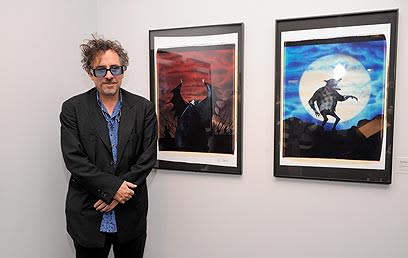
While Johnny Depp was being crowned the sexiest man alive by People magazine yet again, on the other side of the continent his longtime collaborator, the director Tim Burton, is collecting an honor of his own.
Yesterday (Sunday) the Museum of Modern Art in New York (MoMA, for short) opened a major retrospective devoted entirely to Burton and his work. The show runs through April 26, 2010 and holds more than 700 objects connected to Burton’s output, from his first film, Vincent (1982), to the present. It is one of the most intriguing exhibitions at the museum this winter, and it presents Burton in full glory as a filmmaker with a visual sense all his own. The excitement only grew when the video Burton made himself to promote the show came out.
Burton, 51, is an ideal candidate for this kind of exhibition. On one hand, he is the director behind some of the biggest hits of the past two decades (Beetlejuice, Edward Scissorhands, Batman, The Nightmare Before Christmas, Charlie and the Chocolate Factory and more). On the other, he is a singular artist with a visual style that is unmistakably his.
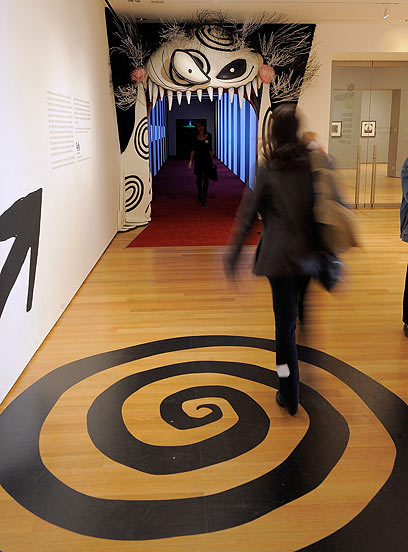
From his childhood in California through art school and on into his films, Burton has been drawn to the gothic, gloomy side of life, while his work and his style are full of childish, naive touches. He likes mixing death with fantasy and nightmare with magic, and he wraps all of it in a package that is painterly and dark but also sugary and babyish. It’s no accident that MoMA calls him a “pop surrealist.”
Growing Up, Still a Kid
The Burton exhibition lays out the unbroken line of his art. Over the years MoMA has mounted some 80 shows devoted to filmmakers. The advantage of a survey like this is that, taken whole, it lets you see a director’s artistic statement, which can take years to develop. Burton, in this case, is a double win: on one hand an interesting artist with a clear statement, on the other a crowd-pleaser whose public treats the exhibition as a sort of tour of Disneyland.
The exhibition opens with a giant wall of Burton’s complete filmography, shelved projects included. From there you step into a space designed in the spirit of his characters (with a heavy emphasis on The Nightmare Before Christmas, which, as it happens, he didn’t direct). Mainstream fans will be thrilled: there is rare memorabilia from films like Edward Scissorhands and Charlie and the Chocolate Factory, with costumes, props and sketches from Burton’s own hand.
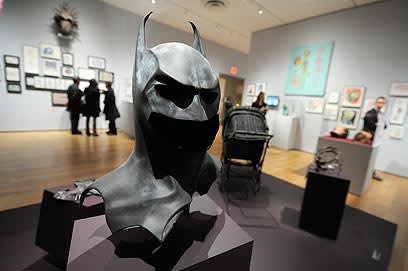
Beyond the memorabilia, though, the emphasis is on his own work over the years. The show includes drawings Burton made as a small boy, puppets he built (at art school and later, in preparation for his films), storyboards he drew, books he wrote and illustrated, and no fewer than several dozen projects that never got made.
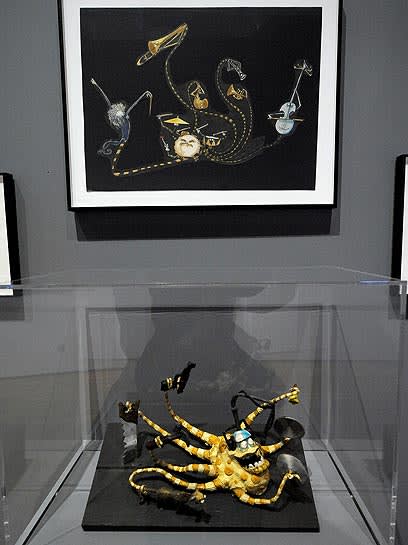
The Burton on view here is not just a director but a painter, photographer, illustrator and storyteller. Wander the rooms and the consistency of his style becomes obvious: the pull toward rounded lines, big eyes, shadowy and fragile characters, who may remind him of the rejected kid he once was. The show also traces Burton growing up, and how he learned to put that peculiar style to work making box-office hits.
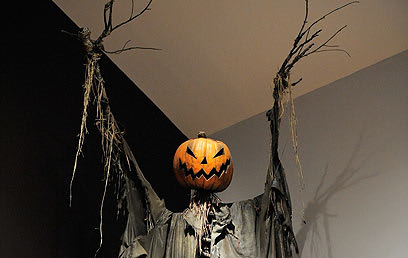
And here an interesting question comes up: it is precisely while wandering past riches like these that you start to think not much has changed along the way. From Burton’s drawings at 14 to hits like The Nightmare Before Christmas there has been development and refinement, certainly, but the core is intact. The gothic-childlike look, the round lines and the attempt to fuse horror with soul have survived 40 years of work very nicely.
In fact, you can see that going back to the same themes and the same designs has not always paid off; several of his recent films were too commercial and delivered neither the freshness nor the magic of the old ones. The conclusion is a director whose films are not always of one standard, but whose vision always is.
Either way, whether you take the exhibition as an art show or as a nostalgic stroll through Burton’s films, it is worth the trip. So far it is shaping up as a hit: visitors are pouring in, the evening tours are packed to the last spot, and the same goes for the film screenings that accompany the show and the other events around the project. No doubt about it, Burton has picked up some not-bad publicity here for his next film, Alice in Wonderland, due in American theaters in March 2010.