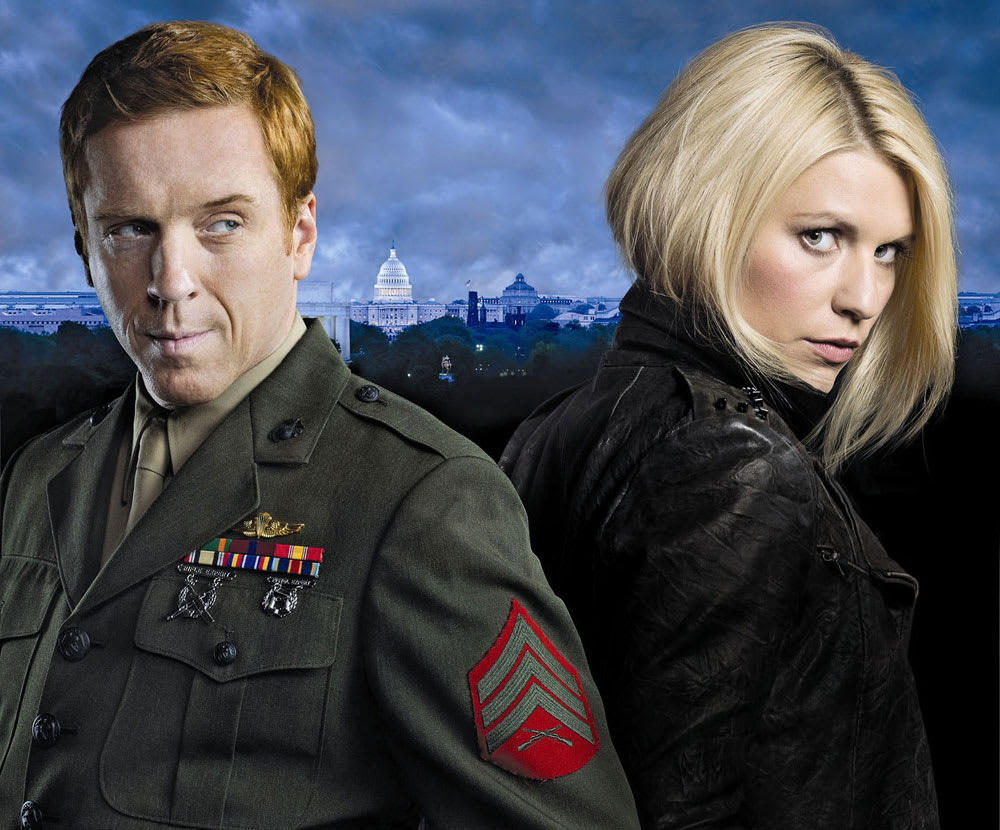
The second season of “Homeland,” Showtime’s quality hit series, is being shot in studios on the outskirts of remote Charlotte. A matter of costs and some significant tax breaks, which have also brought productions like “The Hunger Games,” “Captain America” and “Dawson’s Creek” to shoot in the area.
The atmosphere is as relaxed as a sleepy factory. The series’ crew guards the new season’s plot (which premieres this week on yes and will air five days after the United States) like the Coca-Cola formula. From a storyboard forgotten in a conference room I sneaked into (and got screamed at for it as if I were Jonathan Pollard) I managed to work out that the next scene has Dana, daughter of Sergeant Brody (Damian Lewis, star of “Band of Brothers”), involved in a car chase that ends in a rollover.
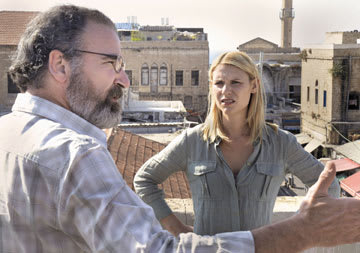
The little the crew agreed to tell about the season is that the most enjoyable part of shooting it was in Israel, for the second year running. Last season the country’s landscapes dressed up as Iraq. This time the country is playing Lebanon.
“Israel is our annual field trip,” laughs Agent Mathison, Claire Danes, the series’ star alongside Lewis and the jewel of the cast. “It would be strange if I weren’t in Tel Aviv next year. I enjoyed it so much there, I wasn’t prepared for all the fun we had in Tel Aviv. Now I already know it in depth, it’s a very cosmopolitan city, far from all the tension and conflicts that get broadcast to the outside.”
Mandy Patinkin, who plays Saul, her boss at the CIA, to perfection, and forever Inigo Montoya from “The Princess Bride”: “In my free time I actually went to see the conflict. I went to the West Bank, I was in Hebron, I visited checkpoints and walked around Ramla. I saw parts that Israelis don’t see. I have family in Israel, secular and religious with the same last name.
“It was very interesting for me to go visit the religious side in the Beit El settlement and see my family name on one of the houses there. At dinner a discussion developed and everyone talked, everyone has an opinion. It was the conflict live. I was very affected by it.”
While Danes and Patinkin were collecting experiences, the series’ producers Howard Gordon and Alex Gansa had to put out the fires.
“Last year, when we shot in a Palestinian village northeast of Jerusalem, the Palestinian liaison didn’t pay the merchants on the street properly,” Gansa recalls. “The result was that we angered them and they started attacking our vehicles. There were no police with us and it was very frightening at certain moments. This year we shot a scene of a Hezbollah demonstration, with Israeli extras burning Israeli and American flags. An Israeli guy saw it and just ran into the scene and started hitting people.”
It was also reported that Gilad Shalit came to visit the set.
“Yes, that was in Jaffa, and throughout the visit he didn’t look us in the eye, not Claire and not anyone around. He was very strange. He said hello, but wasn’t connected at all to what was going on around him. I assumed that’s probably how he survived captivity.”
The “Homeland” studios spread over some 10 dunams, about two and a half acres. A sort of small village. In this village everyone, from the last member of the production crew to the series’ stars, goes out of their way to make “Homeland” what it is: an excellent television product.
In the three days I was there, a crew of some 150 people worked diligently from 8:00 in the morning until 22:00 on shooting the fifth episode of the second season. The product of those days is one scene only (!), in which Agent Mathison interrogates Marine and captive (retired) Nicholas Brody in a musty room, while Saul, Mathison’s boss, paces around them.
What did they do for 14 hours times 3? Shot the same bit again and again and again. This exasperating perfectionism granted me the wondrous ability to recite the text from the end to the beginning.
The village includes areas of changing sets as well as permanent ones, for instance the Brody and Mathison homes, the corridors of Congress and CIA headquarters.
The attention to the smallest details in the design is at a level I have never encountered: for example, the papers lying on the desks at the CIA contain actual intelligence text, and the phones next to the computers carry the agency’s logo on their screens; the drawers in the Brody kitchen hold a full set of cutlery; Mathison’s apartment is so realistic that in the drawer of the home desk I found a stapler, and in her bathroom cabinet I discovered full bottles of medication, including the psychiatric pills she takes.
“Even though many of the items aren’t seen on screen, their purpose is to make us feel the situation is as real as possible,” says Danes. “For example, in Mathison’s house there are traces that constantly remind me of who she is, what kind of life she has. We went far to get inside our characters. It’s important to me to take the character seriously and portray her as accurately as possible. I feel a responsibility, because the more I learn about her illness the more respect I have for the people who deal with it. There isn’t much representation of the illness in pop culture, and I’m grateful that I can do this.”
“Homeland” follows CIA agent Carrie Mathison, who suspects (rightly) that Marine Sergeant Brody, released from captivity in Iraq after languishing there for years, has switched sides and is in fact a terrorist working in the service of his Muslim captors to strike American targets.
The previous season ended with Brody, revealed to viewers as the protégé of the terrorist Abu Nazir, being warmly received in government circles that want to harness his “returned captive” aura to run him for Congress, and failing to carry out his planned attack. But he is also not exposed.
Mathison, who was right all along but failed to expose the truth, goes through a deep meltdown and is hospitalized to treat with electricity the bipolar disorder she suffers from.
The second season opens half a year later, with Mathison recovering at her sister’s house and not planning to return to the CIA, while Brody has managed to become a congressman tightly connected to centers of power. Of course, before long Mathison finds her way back into the Brody obsession and the action resumes.
In Israel people like to point out the Israeli roots of “Homeland,” which is an American adaptation of “Hatufim” (“Prisoners of War”), which Gideon Raff wrote for Keshet. Not many series were born in Israel and then adapted into a series that wins the Golden Globe and the Emmy for best drama, best actor (Lewis), best actress (Danes) and best writing (which Raff also signed).
At any rate, the American crew isn’t all that interested in the Israeli original. In interviews abroad the actors rarely give it credit, and in fact all of them, including Danes and Lewis, admit they never saw the sister from Israel at all.
“I love Gideon and admire his work, but we’re creating our own show here. I didn’t want to rely on something else,” says Danes.
“I didn’t watch it either,” Lewis admits. “I prefer to come fresh, so I tried to stay away from similar incarnations of it. In my research I focused on the character of Brody. I met shell-shocked English veterans, read books about prisoners and went to visit congressmen.”
“The only thing the series have in common is the idea of a prisoner of war coming home,” says Gansa. “In the second season we’re going in a completely different direction.”
The 14-hour shooting days provided me with quite a few moments of idle wandering. As far as the front presented to me goes, the cast never stops stressing that they are a tight, cohesive unit even after the makeup comes off. “We’re already a family,” says Morena Baccarin, the stunning actress who plays Jessica, Brody’s wife. “It’s reinforced by the fact that none of us is from North Carolina. During filming we all live in the same building, which we call ‘the dorms.’ It’s very bonding.
“Besides, Claire and I were in middle school together. We have a shared history, similar friends. It’s fun to share that. We’re always cooking together. Yesterday, for example, Claire texted me that she’d made dinner and I popped over barefoot with wine.”
As in the army, here too it takes time for the new ones to fit in. For instance the British actor Rupert Friend (“Pride & Prejudice” and Keira Knightley’s ex), who joins this season as a mysterious CIA agent.
“They haven’t put me in the dorms yet,” he says. “My entry into the series was fast and nervous, because I was cast a week before filming. I moved straight from London to Charlotte and it was scary to walk right into the group. Luckily, it’s a group that knows how to work together excellently without nonsense. That means I’m not surrounded by internal politics, I just slot straight into the rhythm of the work.”
Both Friend and Lewis are British by origin, a fact that obliges them to keep up an American accent all day (which reverts to British the second they step off the set). Lewis has already played an American soldier in “Band of Brothers”: “In ‘Band of Brothers’ my focus was on combat and action. Here I focused on the character’s psyche, on the way what he went through changed his view of the world.”
And still, the show is trying to make some kind of statement about America.
Gansa: “The statement the series offers is that America is bipolar, like Agent Mathison. We’re right sometimes, we’re wrong sometimes, and every story has two sides, two extremes.”
Lewis: “It’s a show that offers a very liberal view of American involvement in Iraq and Afghanistan. The show is anti-war in my opinion, it uses Republican institutions to present a culture of secrets, lies, hypocrisy, espionage. The bad guys are Muslims, but there’s also a vice president who behaves unethically and shows that governments can be terrorists too.”
Danes: “At first I thought it was dangerous to do a show that deals with provocative ideas still burning in our culture. I wasn’t sure we weren’t exploiting the situation. The more I get into it, the more I think it isn’t political but much more of a psychological thriller.”
Gansa: “At first we worried whether America would even be interested in a series about fighting terrorism. Very few television shows have dealt with it realistically, it’s not as popular a subject as it sometimes seems. I think what makes the series work is the humanity.
“Brody and Carrie are three-dimensional and nothing is black or white like, say, in the series ‘24.’ There are tons of colors on every side, on the terrorism side too, on the American side too. All sides are bad and good. There are several realities.”
It’s a pretty brave move to present an American hero as a terrorist.
Lewis: “I wouldn’t have done the show if it were just simple parallels between Americans and the good guys and Islam and violence. That’s not responsible. They worked here to show that there’s a good force in Islam, that Allah helps Brody survive and serves as salvation for him. In my view it’s a balanced series.”
Patinkin: “To present an American hero who records a suicide speech and accuses the vice president of war crimes is amazing. We show both sides of the argument, without picking a side. I’d like the audience to be haunted by the question of what can be done to resolve the conflict. We pose hard questions: who is responsible for the state of the world? Who are the bad guys and who are the good guys?”
It isn’t only the state of the world that affects the production but more personal factors too, such as the fact that Danes, 33, is pregnant by her husband, the actor Hugh Dancy. It was decided that the pregnancy would not be written into the plot and would be blurred in various ways. Although for now the belly isn’t showing yet (and Danes prefers to keep talk of the subject to a minimum), the fetus finds its way into the water-cooler conversations.
“I can’t wait for this baby to be born!” gushes Patinkin. “I feel like Claire’s father. I admire her, she’s an artist. It’s exciting to watch the life of someone you love develop.”
“For now you can’t see anything,” Danes cools the enthusiasm. “The pregnancy isn’t written into the show and isn’t felt at all on the shoot. I don’t drink coffee, but other than that everything’s fine.”
“It’ll be challenging, but we’re preparing for it,” says Gansa of the future. “We’re already using a double for physical scenes. Later we’ll use various tricks to hide the belly. We’re also planning to use computer graphics to shrink it. Right now we’re talking to the technology people who did it for Anna Paquin’s character in ‘True Blood,’ and she’s actually carrying twins.”
.
Meanwhile, “Homeland” has at least one devoted fan: President Barack Obama. The matter came to light last March, when Lewis was invited to the White House for a dinner in honor of the British prime minister, David Cameron.
“Cameron and Obama came up to me and told me they’re fans of the series,” Lewis recounts. “Of course I asked them when they have time to watch the show when they’re busy running the world. So Cameron said he watches while he’s getting ready to leave the house, and Obama said that when his wife, Michelle, takes the girls to play tennis on Saturday afternoon, he pretends he’s going to work and instead turns on the TV and watches ‘Homeland.’”
Are you planning to exploit the connection?
Lewis: “Of course. I explained my economic plan to Obama. You could say I solved all his problems for him.”